Scanning the heavens

Well, I had the scan at 12.30 this afternoon. (This was slightly earlier than the initial appointment.) All went pretty well.

The prepping is pretty easy; no need to fast, just drink 0.5 litre of water beforehand. However, there is a lot of waiting around involved. You arrive and check in, pay $575, and get a form to fill in. (The payment is because the PSMA PET scan, although there is a lot of evidence for its suitability for prostate cancer, is not on the federal government’s list of approved treatments. There is what looks like a good brief account of how it works here. I may get something back on the health fund; have yet to ring them.)

Person no. 1 comes to collect you, put you in a cubicle and give you some pyjama bottoms to change into. You get asked your full name and date of birth (several times). Person no. 2 puts a cannula in your arm, another comes and gives you the injection of the radioactive material.  Person no. 2 or 3 then gives you a diuretic. This really works – I had to go to the bathroom about four times beforehand, and just after (see below). This gives you something to do during the hour, give or take, in which the radioative stuff gets circulating. I knew to bring a book, so read a bit more of The magic mountain, and a very interesting article from the New Yorker by Siddharta Mukherjee about equilibrium. (This link may or may not resolve to the full text; non-subscribers get three a month, I think it is. If not, the brief citation is My father’s body, at rest and at motion: New Yorker, 8 January 2018. No, I don’t know how they publish in advance either!)

One or other of the preceding dramatis personae ushers you in to have the scan itself. This bit takes about half an hour. The PET scan is not as bad as an MRI, where you feel as if you are being inserted into a pizza oven. The former is bigger and a lot quieter. After a few explanations, everyone leaves the room (doubtless to reduce their exposure). You get put in by varying degrees as different bits are scanned. You have to have your arms above your head, but get a cord to hang onto.

Despite being able to see out alternately at either end, I started to feel a bit claustrophobic towards the end. Conjugating sein and haben (the only German verbs I can remember) only got me so far. Added to that, I needed to have another pee. I held out as long as I could, then said “Excuse me”. Fortunately, I got an immediate reply. I was requested to wait thirty more seconds, and I was counting these down! Then, as they used to say in TAFE, I made like a blacksmith and made a bolt for the door.

I won’t get to discuss the results with Jeremy until 1 February, as he is on holiday until then. Of course, this information will be posted in excruciating detail! I felt quite OK afterwards. My beloved went to the gym; I put some solar lights in the bed with the bamboos, then put the new hose on our new hose reel. Actually, this last process was a lot more difficult than I am making it sound. The hose went on OK at first, after I got all the kinks out of it. (I had straightened it out and left it in the sun before leaving for the hospital, so it wasn’t as bad as if it just been unwrapped.) Then all of a sudden, it went really loose and peculiar, and wouldn’t reel on or off. After pulling about 10 metres of it off (i.e. passing it back under the handles, loop by loop), I discovered that a bit had gotten stuck under one of the horizontal bars at the bottom that hold the sides together. Having rectified this, I pulled all 30 metres of it off the reel, then carefully reeled it on again, keeping some tension on it the while.

I had assembled the reel this morning, and can tell you, when they say “no tools required for assembly” on the box, this is definitely fake news! The assembly instructions are also a masterpiece of omission. After having to take the thing apart several times (still managing to put the angled hose joint the wrong way into the reel hub), I did test it and can report that it works in spite of my and Pope’s best efforts. Why didn’t we get an automatic self-retracting one? Most of the reviews say these become more trouble than they are worth. They also need to be mounted on a wall,  requiring me to drill holes with a masonry bit. I suspect my beloved did not wish to put my handyman skills to this test, and thus bestowed the all important WAF (Wife Acceptance Factor) on the manual windup model.
Silent accumulator

Well, another birthday rolls around. It was a terrific day actually. I got brought tea and toast in bed. Then when my beloved and I got up, more presents, and a couple of phone calls from family members (more of the latter in the afternoon). I walked with herself around to the gym. She went in, I kept going, and went home and had a coffee. ABC Classic was playing the Tchaikovsky Concerto no. 1 with Simon Tedeschi; very good. We had lunch at an Italian place in Camberwell; I had roast duck with polenta and a pinot noir, then a very good raspberry mousse with a sort of crunchy pistachio garnish, which gave it a great textural lift. All excellent. I needed a rest after that!

In the afternoon, some ginger tea and panforte, and we watched another episode of Berlin Station. Then we had a champagne; I had pushed the boat out and gotten a Mumms brut to try. Lots of bubbles, and an interesting, rather chablis-like, minerally style. It grew on both of us; it starts short but ends long. (Der Fisch still prefers prosecco.) I remembered that I had another Tchaikovsky PC1, this one with Martha Argerich, so we listened to that with the drink. This is a good version too, and sounds very full for a recording dating from 1971. There was enough dinner left over from yesterday, so I didn’t have to make anything. (I was still pretty full from lunch and the snack, so just had cheese on toast – Dad would have approved!) More good music on FM.

There will be few commercial endorsements on this blog, and they will all be honorary. So when I mention the powerbank that is allowing me to type this, you know it is on the strict QT. This is a Cygnett ChargeUp Pro 20K, which was one of my presents from my beloved. (You all know what a powerbank is. Charge it up; then, when your phone or tablet runs out of charge, just plug it into the powerbank, and you can keep chatting or typing.) My old Samsung tablet is on its second battery after three years. I put the screen brightness down whenever possible, keep fewer browser tabs open, and have switched on power saving. Even so, it never goes more than a day without needing a charge. The Cygnett only needed a few hours to charge up completely. When the tablet battery dropped to 15%, at which point it starts complaining, I plugged in the powerbank. After an hour or so of web browsing, then blogging, the tablet battery is on 38% and rising. So it is a pretty grunty device. (An honourable mention to Dick Smith also. When Der Fisch ordered it, she accidentally ordered something else instead. They cancelled the incorrect order, refunded the charge, and got her the correct thing.)

I booked a PSMA/PET scan at The Alfred on 3 January. Jeremy is away until February, but I have an appointment with him early in that month. New Year’s resolutions: read The magic mountain and Godel, Escher, Bach. (I have gotten a few chapters into the latter, up to the one about the propositional calculus. I actually did read this chapter, but need to have another go, after taking notes about what the symbolic operators stand for.) Happy new year to all!

Danger music

This book by Eddie Ayres is a cracker. A viola player who at one time played with the Hong Kong Philharmonic, Ayres also worked as a radio host on ABC Classic FM, and rode a bicycle from the UK to Hong Kong, carrying a violin. (This journey was the subject of Ayres’ previous book Cadence.) His more recent book, Danger music, tells the story of teaching string players at Afghanistan’s National Music Academy in Kabul. Ayres, who went to Afghanistan as Emma, also decided while there to transition from female to male. This interior journey is counterposed to Ayres’ Kabul experiences as a kind of descant to the main narrative, one that gradually becomes more insistent.

Danger music features a wealth of sharply etched characters and telling incidents. The pupils of the Academy and Ayres’ colleagues and housemates are realised as individuals. His delight in his best pupils’ talent and motivation is mixed with despair at the laziness and venality of others. He is scathing about the impoverished roles that girls are often expected to play in the fundamentalist Islamic culture created by the Taliban. One comes to realise what an incredible achievement it is to found, fund and operate a music academy in a country where being found playing an instrument or listening to instrumental music had been forbidden. His delight in contributing to his pupils’ personal and musical growth is gradually undermined by frustration at the corruption and lack of accountability in which the country still seems mired.

Ayres’ questing life seems to have taken him to many difficult places in the world. None was more challenging than his decision, painfully arrived at, to begin gender transition. I wish that those who blathered about gender fluidity in the recent debate about same sex marriage had been able to read this book. Had they done so, they would know that the gender transition process is not something that is done neither on a whim, nor does it have any political aspect. It involves a change to something basic to our identity. A nagging sense of being in the wrong body, of being the wrong gender, is a feeling that most people will probably never have. (This does not make it a wrong or bad feeling to have.) Ayres had been pushing aside this inner voice for some time, and this took a tremendous toll on him; his struggles with alcohol and suicidal thoughts are described unsparingly. His description of the acceptance he receives from his friends and family is moving. The narrative ends on an optimistic note. Ayres comes across as a generous, observant, and compassionate person. One would need a hard heart not to wish him well in the love he has finally found.

This book spoke to me personally in a couple of ways. First, I studied the cello for 12 years. I gave up after realising I would never achieve the standard that I wanted to, or anything like it. In this process I had many advantages; a wonderful teacher, living in a first world country that is not undergoing a civil war, with the rule of law, dependable power supplies, and where hardly anyone cares if you play music. Ayres’ pupils obviously had a great teacher, but none of the other advantages I enjoyed, and many more obstacles as well. Their achievement seems in this light all the more extraordinary. Second, someone extremely dear to me has undergone gender reassignment. (For various reasons, I can’t identify them.) People who undertake this journey want what everyone wants, to be their best selves. Ayres’ book made me realise emotionally (not just intellectually) what raw courage it takes to reshape oneself in this way.


Pretty good Christmas

The operation having been only six or seven weeks ago, neither my beloved nor I felt like much of a hoedown at Christmas. We usually go to family, who are always very welcoming, but a few hours drive away. While I am still dealing with moderate urinary incontinence, going down and back in the one day seemed quite an expedition. So we just had lunch at home. It was a perfect day, as it turned out, about 24 degrees, so we put the umbrella up and sat in the courtyard.

Our wedding anniversary and my birthday both fall in December; when one adds Christmas, the month gets crowded. All these events create an extra pressure to remember and arrange things, something which anyone who knows me will realise was never my strong suit. Fortunately I had gotten my beloved a couple of nice gifts earlier in the month. (I did come to the party also for our anniversary with a gift voucher for a mani and pedi.) So if my offerings were few in number on the day, I had at least made an effort previously, and cooked the meal as a contribution in kind to the festivities.

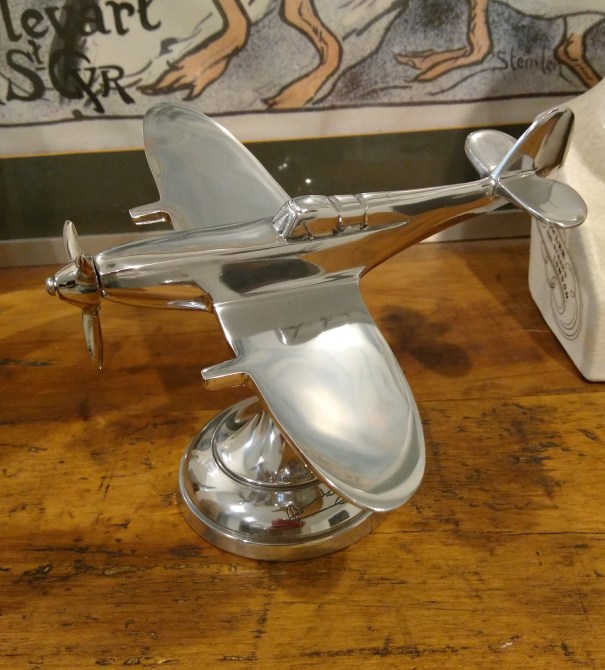
Because we are usually part of a much bigger effort at Christmas (mostly on the part of our hosts), I had rather drifted into it food-wise this year. I had thought about it to the extent of prepping some brined chicken as the basis for a main course. For a support act there were potatoes, one parsnip, and some rather ancient bits of pumpkin. I cooked some frozen peas for Der Fisch, which she likes. If this is all starting to sound a bit O Henry, it was actually fine. We had a couple of glasses of a New Zealand sauvignon blanc supplied by Messrs Aldi & Co. This and a big meal for lunch, by my standards, knocked me out for an hour or so. I did get some lovely presents, including a very generous music voucher from my sister. My beloved gave me a beautiful shirt and an art deco-style model of a Spitfire, the E-type Jaguar of planes; see below.

IMG_20171226_223334901.jpg

Yesterday we did some work in the courtyard, sweeping, weeding, and fertilising. After a coffee, a lovely phone call from my brother, and a bit of Christmas cake (Aldi to the rescue again), I ventured forth to replenish the stores. In the afternoon I alternately watched the Boxing Day test and read Eddie Ayres’ fascinating book Danger music, which I will review separately.  So Christmas was gotten through actually very pleasantly. I said to my beloved that I wouldn’t have changed anything. The message from the sister-in-law about yesterday was very thoughtful, and it was nice to have been missed; the presence of an absence, as someone said. Likewise; normal service should be resumed next year.

Memento mori

The cancer diagnosis has had a number of different impacts on me, my beloved, and my family. There is the practical impact, mostly felt by me and der Fisch, of having to get to appointments, take in information, decide between treatment alternatives, and do the practical things required (pay bills, get prescriptions and other supplies, read online forums and so on). This also involves changing my behaviour in various practical ways, like always having spare pads to change into when I go out.

There is also an emotional impact of realising that I probably won’t be around as long as I had thought. I am mostly conscious of this for me and my beloved, but others may feel this too. When I first walked into Jeremy’s office I had a life expectancy of maybe 25 years. (My mother died at 94.) This wasn’t just a big cushion of years between me and my death; it influenced all sorts of practical choices I had to make, like how to set up my super at retirement. Knowing now that my life is likely to be quite a bit shorter than I had expected was quite a big thing to get used to. I think I went through a grief process for the years I now knew I wouldn’t have. At this time, my emotions were close to the surface. I know my beloved has also had periods of anxiety and stress, particularly after my initial diagnosis. (I think she keeps these mostly to herself so as not to burden me; one more reason for me to be profoundly thankful that she’s around.)

How long am I likely to get? I haven’t been offered a prognosis, and don’t feel the need for one. Even if I did have a specific figure, I know that life expectancy of prostate cancer patients can vary tremendously. So any figure would be a statistical estimate, based on many variables, the type of cancer and treatment modalities being two. So it is a number, plus or minus X. I have made my own investigations, and feel that I have a range of years to which, all going well, it is reasonable to look forward. Surprisingly,  I feel I have adjusted to these horizons.

It is a bit Magic mountain at present; I know rationally I am sick, but I feel perfectly well. This knowledge, however, forms a background against which everything else is seen. A lot of the things we obsess about seem quite trivial. I used to obsess about them until quite recently, so I am not judging people for doing this. But I do feel more detached, and have to remind myself that not everyone is feeling or can feel this way. Knowing that there are fewer years to go somehow makes life more vivid, like colours which have become twice as concentrated.

Postscript: The Prostate Cancer Treatment Research Foundation summarises the effects of different treatment on low, high or medium risk cancers in graphical form at their web site. The graph applicable to me is this one .

Consults with Jeremy and Susannah

We had our consultation with Jeremy this morning. As discussed, the focus was initially on the PSA test I had done on the 12th (this being about 6 weeks after the operation). The level was 0.9, whereas the previous test (prior to the surgery) had been 9.9. Obviously the former seems a lot better than the latter. Following a prostatectomy, however, the desirable level is 0.0. So anything higher than 0.5 confirms some residual disease. The question is, where? Another scan is required to locate and determine what is going on. I am therefore going to have another whole body PSMA/PET procedure at the Alfred – they are going to ring me to set this up. This will probably be in January.

While it is slightly disappointing not to be home free, I didn’t actually expect the test result to come back zero. So as far as I am concerned, it is not as bad as it could have been. If the disease is within the pelvic area, radio therapy can be used (see no. 3 below). Jeremy is always keen to point out the positives:

  1. I have had the optimal first treatment, i.e. the prostatectomy. (Jeremy said last time this would have removed 99% of the cancers.) Therefore we are not in a rush to determine the next treatment.
  2. The disease is PSMA-avid. This makes it easier to see it because it shows up on a PSMA-PET scan. Easier to see means that
  3. Stereotactic radio therapy can be used. This is a specific kind of RT with much lower side effects. A 2016 study of stereotactic body radio therapy found “a 98.6 percent cure rate with SBRT, a noninvasive form of radiation treatment that involves high-dose radiation beams entering the body through various angles and intersecting at the desired target. It is a state-of-the-art technology that allows for a concentrated dose to reach the tumor while limiting the radiation dose to surrounding healthy tissue.”

I also saw Susannah the physio this afternoon. She is encouraging me to become less reliant on pads. (The urinary continence has certainly improved since I saw her last.) She said that going pad-free speeds up recovery of more normal levels of continence, and is better for the perineal region. Obviously I will be selective about when I do this, e.g. not while engaged in activities that cause leaking, while I have people over, etc.

I have a new exercise to do, which involves bending over to pick up a 2 kilo weight. I am to do this 15 times. (Needless to say I will be engaging the pelvic floor the while.) The aim of this exercise is to teach the muscles greater endurance. I will check in with her again when I know the date of the PSMA/PET scan.

It has been very hot here, about 37 at one point. The change has come through and dropped the temperature to 23, with some rain.

My new tuner

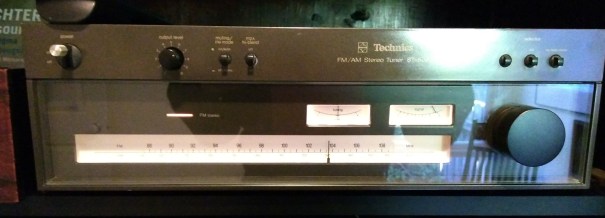
Here is my new (to me) Technics tuner …

Tuner II.jpg

This is the reason that I defected from Blogger to here. I attempted to upload this image to the old Blogger blog. Nothing. Well known fault. Well, I am too intolerant of things not working. I ain’t got time!

I have decided to stop listening to digital radio, FM sounding a lot less artificial. This is made possible by the fact that we are sitting near the top of a ridge with good sightlines to Mount Dandenong, where a lot of stations have their transmitters. Anyway, I had quite a happy hour or so in the Melbourne Hifi Exchange browsing among the vintage FM tuners. There is a great site called fmtunerino.com which has reviews of hundreds of tuners, and which I referred to before and during the visit. There was a nice looking Marantz tuner, but unfortunately this had sold. Some tuners are “collectable”, i.e. people buy them for their looks rather than their performance. I finally selected a Technics tuner which was quite well reviewed, looks the business, but isn’t collectable and thus was reasonably priced. Here is a comparo with the most favoured tuner http://www.fmtunerinfo.com/shootouts.html#ST-8080 . The guy plugged it into his stereo to demonstrate it, and a fellow customer held up the ribbon aerial for me! (I swapped notes with the latter about having his Luxman tube power amp fixed, which sounds like a similar model to mine. Having been through it and parted with a fair chunk of cash, I was able to advise him, as per the Nike ad, “Just do it”.) The place is really more of a hobbyist hangout than a proper shop, but all rather good fun.

Doing their business in great waters

I know I can appear a little obsessed at the moment with knocking the dew off the lily (see previous post: and do pay attention!). However, if one goes from never thinking about urinary continence, to its being actively a problem, it is quite a transition. One can start avoiding social activity, because it can lead to embarassment. And you all know that social engagement is a marker of health.

These thoughts were prompted by seeing the physio from Jeremy’s practice this morning. I had seen this lady previously to learn that I did have a pelvic floor, actually, and I had to get it into shape for post-operative duty. (At the risk of repeating myself, these muscles have to take over urinary and faecal continence from the prostate.) So this was a follow-up visit. I had a fairly mixed report card to relate. I have been able fairly much to engage the PFMs when getting up, and for long enough to reach the bathroom. Sneezing, coughing, laughing etc. are all pretty well under control. However, standing up for any time definitely brings about leakage. The habit of pre-emptive loo visits to head this off is to be discouraged. (The idea is to get back to going when the need arises, and holding on between.)

This consult was encouraging in giving me some techniques to practice and develop that will help bring this about. The physio also reminded me that PFMs, like any other muscle, get tired, particularly toward the end of the day. It was a judicious mixture of encouragement and stuff to concentrate on. I am liking this team approach to medicine, where after the specialist does what they uniquely do, their team gets the patient back to full functioning.