Mundane Monday
Well, OK (cliche alert), after all the talk about exercising and generally being sensible, it’s time to walk the walk. My steps tended today to the local gym, where I did a cautious and pretty light workout. Nothing on the lower body, not wanting to stir those mets up! So just 15 minutes on the recumbent bike, then a few upper body exercises. Walking there and back, plus the three loads of washing which I hung out earlier, have added up to 5,883 steps, about 4.5 kilometres. (Strangely, although I have just been sitting here typing, the Fitbit just buzzed, and it has gone up to 6,000 steps. Whatevs!) I even hopped on the scales at the gym, and got a pleasant surprise. I had been about 92 kilos, and am now 87. I knew I had lost weight since the operation, the appetite having mostly gone missing, but when this started to return, I thought I had put the weight all back on.
It definitely has been an indulgent few weeks, making jam, marmalade and banana bread, and discovering the delights of French champagne. Shopping in the liquor department, I thought “What the hell” and got a few bottles of Mumms. Well, what a great drop. Steely and minerally, plenty of bead, and a flavour that keeps going for the whole bottle. It drinks very well the next day too. (I really must get a proper bottle sealer.) The Piper Heidsieck isn’t bad either, although I still prefer the Mumms. My beloved innocently mentioned that she would like to try a Krug. I did a quick online search and thought “Yes, it’s really quite expensive”. However, in a different liquor shop they had it for $70 or $80 more! I mentioned I had seen it elsewhere for less, they checked and said “We can price match that”, so I got one of those and another couple of Mumms. The Krug is a pretty extraordinary drink; huge mouth-filling flavour, fine bead, and you can definitely keep swilling it down. A friend came over for lunch yesterday, and we got through the bottle, no problems. Fortunately, I didn’t think it was five times as good as the Mumms. They both leave your mouth in much better shape than the Aussie sparkling wines, even the “traditional method” ones, which leave me feeling quite dried out. Maybe the French ones don’t have so much sulphur dioxide; perhaps they use better material. Anyway, I am going to restrict myself to a bottle of Mumms each month, and a Krug as an annual treat.
To round out the miscellany, I came across a really polemical piece by Elizabeth Wurtzel in The Guardian, I have cancer. Don’t tell me you’re sorry. (Apologies if this link doesn’t work. When I put in a link at the end of a sentence, I always leave a gap between the URL and the full stop. If I do that here, however, WordPress tries to make all the following text part of the URL as well. Here is the whole link if the inline version doesn’t resolve: https://www.theguardian.com/commentisfree/2018/jan/20/cancer-elizabeth-wurtzel?CMP=Share_AndroidApp_Gmail . I tested it and it works for me; email or leave a comment if you strike problems.)
I’ll let you read the piece before I post my reactions to it. I look forward to emails or comments. I haven’t quite worked out what I think of it yet. But it is quite an incendiary piece of writing.
Extra ordinary
First, apologies for a bit of a hiatus. I wanted to let family know about the bone metastases mentioned in the previous post before I published it. I did let them know, then wrote the post, but forgot to press “Publish”. When I opened the blog tab just now, it was still sitting there. Anyway, it has been dispatched.
The other reason for the presence of an absence, as far as posts go, is that I am marking time until I see Pat Bowden on 6 February. Talking to my sister a couple of days ago, I was reminded of something I read about the film making process. The author, whoever it was, likened it to war. According to him, both were marked by long periods of waiting around separated by bursts of panicked activity (or something along those lines). I am definitely in the former state. (Actually, it is all very Magic Mountain, something that will be the subject of a future post when I get a bit further through it.)
Unpromising as it may appear, a lack of dramatic incident has been quite an interesting thing. The reading I have done around bone mets suggests that those whose cancer has taken this turn can help the treatment along by looking after their bone health. This includes flossing, maintaining bone density, and generally not being too much of a slob. Weight bearing exercise can help reduce the side effects of treatments such as radiation therapy. Sound familiar? Yes, we are back in New Year’s resolution territory; eat less, move more.
This has a slight weirdness about it. A cancer diagnosis redraws the time horizons. I was also told not to exercise following the surgery. Now I am back having to do stuff that, like most people, I find fairly tedious to do. Still, it gives one a very specific reason to do these things, not just because they are good in a vague way. I am still feeling fine, just having trouble concentrating. Again, I have to focus on the absence of something, in this case pain, and be thankful for that (which I certainly am).
As well as having to get off my backside more, I realise that I need some mental activity. It has been difficult to think of something interesting, and that I can take up and put down as treatments unfold. This precludes most courses taught in bricks and mortar institutions. So I am taking up German again, via a couple of Coursera online programs. These are self-paced; I have only just enrolled in them, so have nothing to report just yet here either. There will be! Soon!
An unwelcome development
I had a call from Jeremy on Wednesday. I am learning that this is not a good thing! Unfortunately, but as expected, there are some recurrences of the cancer. They are all in bone, in the left hip and left femur. Fortunately they (three in total) are all very small; I think Jeremy said 1 centimetre or less. He rang me to request my permission to refer me to a radiation oncologist at Epworth, Dr Pat Bowden (to which of course I agreed). I am waiting to hear from him. Hormone therapy is the usual therapy for these metastases, but Dr Bowden is being brought in to see whether radiation therapy might be a good treatment.
Learning about these bone metastases, I was a bit shaken. However, I found out a bit more about them, which has helped put them in some context. Apparently they are very common in advanced prostate cancer. I found a good article about treating bone metastases here . (I will add this site to my Resources list in my blog.) One of the radiopharmaceuticals mentioned in the article, Xofigo, has just been approved for inclusion on the PBS in Australia. Anyway, I will see what Dr Bowden says. I am just thankful that I am pain free at present, and getting what seems like expert and very active surveillance and treatment. Also one must bear in mind that these are very small beasties, and thus presumably more able to be stopped or slowed down.
Scanning the heavens
Well, I had the scan at 12.30 this afternoon. (This was slightly earlier than the initial appointment.) All went pretty well.
The prepping is pretty easy; no need to fast, just drink 0.5 litre of water beforehand. However, there is a lot of waiting around involved. You arrive and check in, pay $575, and get a form to fill in. (The payment is because the PSMA PET scan, although there is a lot of evidence for its suitability for prostate cancer, is not on the federal government’s list of approved treatments. There is what looks like a good brief account of how it works here. I may get something back on the health fund; have yet to ring them.)
Person no. 1 comes to collect you, put you in a cubicle and give you some pyjama bottoms to change into. You get asked your full name and date of birth (several times). Person no. 2 puts a cannula in your arm, another comes and gives you the injection of the radioactive material. Person no. 2 or 3 then gives you a diuretic. This really works – I had to go to the bathroom about four times beforehand, and just after (see below). This gives you something to do during the hour, give or take, in which the radioative stuff gets circulating. I knew to bring a book, so read a bit more of The magic mountain, and a very interesting article from the New Yorker by Siddharta Mukherjee about equilibrium. (This link may or may not resolve to the full text; non-subscribers get three a month, I think it is. If not, the brief citation is My father’s body, at rest and at motion: New Yorker, 8 January 2018. No, I don’t know how they publish in advance either!)
One or other of the preceding dramatis personae ushers you in to have the scan itself. This bit takes about half an hour. The PET scan is not as bad as an MRI, where you feel as if you are being inserted into a pizza oven. The former is bigger and a lot quieter. After a few explanations, everyone leaves the room (doubtless to reduce their exposure). You get put in by varying degrees as different bits are scanned. You have to have your arms above your head, but get a cord to hang onto.
Despite being able to see out alternately at either end, I started to feel a bit claustrophobic towards the end. Conjugating sein and haben (the only German verbs I can remember) only got me so far. Added to that, I needed to have another pee. I held out as long as I could, then said “Excuse me”. Fortunately, I got an immediate reply. I was requested to wait thirty more seconds, and I was counting these down! Then, as they used to say in TAFE, I made like a blacksmith and made a bolt for the door.
I won’t get to discuss the results with Jeremy until 1 February, as he is on holiday until then. Of course, this information will be posted in excruciating detail! I felt quite OK afterwards. My beloved went to the gym; I put some solar lights in the bed with the bamboos, then put the new hose on our new hose reel. Actually, this last process was a lot more difficult than I am making it sound. The hose went on OK at first, after I got all the kinks out of it. (I had straightened it out and left it in the sun before leaving for the hospital, so it wasn’t as bad as if it just been unwrapped.) Then all of a sudden, it went really loose and peculiar, and wouldn’t reel on or off. After pulling about 10 metres of it off (i.e. passing it back under the handles, loop by loop), I discovered that a bit had gotten stuck under one of the horizontal bars at the bottom that hold the sides together. Having rectified this, I pulled all 30 metres of it off the reel, then carefully reeled it on again, keeping some tension on it the while.
I had assembled the reel this morning, and can tell you, when they say “no tools required for assembly” on the box, this is definitely fake news! The assembly instructions are also a masterpiece of omission. After having to take the thing apart several times (still managing to put the angled hose joint the wrong way into the reel hub), I did test it and can report that it works in spite of my and Pope’s best efforts. Why didn’t we get an automatic self-retracting one? Most of the reviews say these become more trouble than they are worth. They also need to be mounted on a wall, requiring me to drill holes with a masonry bit. I suspect my beloved did not wish to put my handyman skills to this test, and thus bestowed the all important WAF (Wife Acceptance Factor) on the manual windup model.
Silent accumulator
Well, another birthday rolls around. It was a terrific day actually. I got brought tea and toast in bed. Then when my beloved and I got up, more presents, and a couple of phone calls from family members (more of the latter in the afternoon). I walked with herself around to the gym. She went in, I kept going, and went home and had a coffee. ABC Classic was playing the Tchaikovsky Concerto no. 1 with Simon Tedeschi; very good. We had lunch at an Italian place in Camberwell; I had roast duck with polenta and a pinot noir, then a very good raspberry mousse with a sort of crunchy pistachio garnish, which gave it a great textural lift. All excellent. I needed a rest after that!
In the afternoon, some ginger tea and panforte, and we watched another episode of Berlin Station. Then we had a champagne; I had pushed the boat out and gotten a Mumms brut to try. Lots of bubbles, and an interesting, rather chablis-like, minerally style. It grew on both of us; it starts short but ends long. (Der Fisch still prefers prosecco.) I remembered that I had another Tchaikovsky PC1, this one with Martha Argerich, so we listened to that with the drink. This is a good version too, and sounds very full for a recording dating from 1971. There was enough dinner left over from yesterday, so I didn’t have to make anything. (I was still pretty full from lunch and the snack, so just had cheese on toast – Dad would have approved!) More good music on FM.
There will be few commercial endorsements on this blog, and they will all be honorary. So when I mention the powerbank that is allowing me to type this, you know it is on the strict QT. This is a Cygnett ChargeUp Pro 20K, which was one of my presents from my beloved. (You all know what a powerbank is. Charge it up; then, when your phone or tablet runs out of charge, just plug it into the powerbank, and you can keep chatting or typing.) My old Samsung tablet is on its second battery after three years. I put the screen brightness down whenever possible, keep fewer browser tabs open, and have switched on power saving. Even so, it never goes more than a day without needing a charge. The Cygnett only needed a few hours to charge up completely. When the tablet battery dropped to 15%, at which point it starts complaining, I plugged in the powerbank. After an hour or so of web browsing, then blogging, the tablet battery is on 38% and rising. So it is a pretty grunty device. (An honourable mention to Dick Smith also. When Der Fisch ordered it, she accidentally ordered something else instead. They cancelled the incorrect order, refunded the charge, and got her the correct thing.)
I booked a PSMA/PET scan at The Alfred on 3 January. Jeremy is away until February, but I have an appointment with him early in that month. New Year’s resolutions: read The magic mountain and Godel, Escher, Bach. (I have gotten a few chapters into the latter, up to the one about the propositional calculus. I actually did read this chapter, but need to have another go, after taking notes about what the symbolic operators stand for.) Happy new year to all!
Danger music
This book by Eddie Ayres is a cracker. A viola player who at one time played with the Hong Kong Philharmonic, Ayres also worked as a radio host on ABC Classic FM, and rode a bicycle from the UK to Hong Kong, carrying a violin. (This journey was the subject of Ayres’ previous book Cadence.) His more recent book, Danger music, tells the story of teaching string players at Afghanistan’s National Music Academy in Kabul. Ayres, who went to Afghanistan as Emma, also decided while there to transition from female to male. This interior journey is counterposed to Ayres’ Kabul experiences as a kind of descant to the main narrative, one that gradually becomes more insistent.
Danger music features a wealth of sharply etched characters and telling incidents. The pupils of the Academy and Ayres’ colleagues and housemates are realised as individuals. His delight in his best pupils’ talent and motivation is mixed with despair at the laziness and venality of others. He is scathing about the impoverished roles that girls are often expected to play in the fundamentalist Islamic culture created by the Taliban. One comes to realise what an incredible achievement it is to found, fund and operate a music academy in a country where being found playing an instrument or listening to instrumental music had been forbidden. His delight in contributing to his pupils’ personal and musical growth is gradually undermined by frustration at the corruption and lack of accountability in which the country still seems mired.
Ayres’ questing life seems to have taken him to many difficult places in the world. None was more challenging than his decision, painfully arrived at, to begin gender transition. I wish that those who blathered about gender fluidity in the recent debate about same sex marriage had been able to read this book. Had they done so, they would know that the gender transition process is not something that is done neither on a whim, nor does it have any political aspect. It involves a change to something basic to our identity. A nagging sense of being in the wrong body, of being the wrong gender, is a feeling that most people will probably never have. (This does not make it a wrong or bad feeling to have.) Ayres had been pushing aside this inner voice for some time, and this took a tremendous toll on him; his struggles with alcohol and suicidal thoughts are described unsparingly. His description of the acceptance he receives from his friends and family is moving. The narrative ends on an optimistic note. Ayres comes across as a generous, observant, and compassionate person. One would need a hard heart not to wish him well in the love he has finally found.
This book spoke to me personally in a couple of ways. First, I studied the cello for 12 years. I gave up after realising I would never achieve the standard that I wanted to, or anything like it. In this process I had many advantages; a wonderful teacher, living in a first world country that is not undergoing a civil war, with the rule of law, dependable power supplies, and where hardly anyone cares if you play music. Ayres’ pupils obviously had a great teacher, but none of the other advantages I enjoyed, and many more obstacles as well. Their achievement seems in this light all the more extraordinary. Second, someone extremely dear to me has undergone gender reassignment. (For various reasons, I can’t identify them.) People who undertake this journey want what everyone wants, to be their best selves. Ayres’ book made me realise emotionally (not just intellectually) what raw courage it takes to reshape oneself in this way.
Pretty good Christmas
The operation having been only six or seven weeks ago, neither my beloved nor I felt like much of a hoedown at Christmas. We usually go to family, who are always very welcoming, but a few hours drive away. While I am still dealing with moderate urinary incontinence, going down and back in the one day seemed quite an expedition. So we just had lunch at home. It was a perfect day, as it turned out, about 24 degrees, so we put the umbrella up and sat in the courtyard.
Our wedding anniversary and my birthday both fall in December; when one adds Christmas, the month gets crowded. All these events create an extra pressure to remember and arrange things, something which anyone who knows me will realise was never my strong suit. Fortunately I had gotten my beloved a couple of nice gifts earlier in the month. (I did come to the party also for our anniversary with a gift voucher for a mani and pedi.) So if my offerings were few in number on the day, I had at least made an effort previously, and cooked the meal as a contribution in kind to the festivities.
Because we are usually part of a much bigger effort at Christmas (mostly on the part of our hosts), I had rather drifted into it food-wise this year. I had thought about it to the extent of prepping some brined chicken as the basis for a main course. For a support act there were potatoes, one parsnip, and some rather ancient bits of pumpkin. I cooked some frozen peas for Der Fisch, which she likes. If this is all starting to sound a bit O Henry, it was actually fine. We had a couple of glasses of a New Zealand sauvignon blanc supplied by Messrs Aldi & Co. This and a big meal for lunch, by my standards, knocked me out for an hour or so. I did get some lovely presents, including a very generous music voucher from my sister. My beloved gave me a beautiful shirt and an art deco-style model of a Spitfire, the E-type Jaguar of planes; see below.
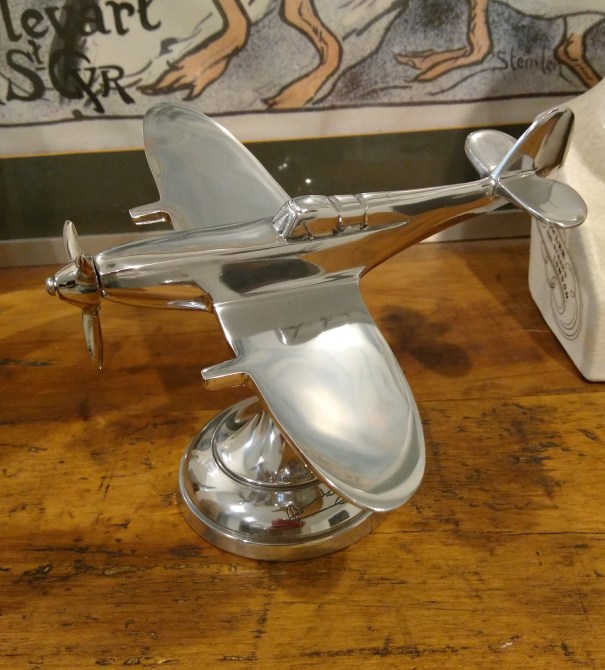
Yesterday we did some work in the courtyard, sweeping, weeding, and fertilising. After a coffee, a lovely phone call from my brother, and a bit of Christmas cake (Aldi to the rescue again), I ventured forth to replenish the stores. In the afternoon I alternately watched the Boxing Day test and read Eddie Ayres’ fascinating book Danger music, which I will review separately. So Christmas was gotten through actually very pleasantly. I said to my beloved that I wouldn’t have changed anything. The message from the sister-in-law about yesterday was very thoughtful, and it was nice to have been missed; the presence of an absence, as someone said. Likewise; normal service should be resumed next year.
Memento mori
The cancer diagnosis has had a number of different impacts on me, my beloved, and my family. There is the practical impact, mostly felt by me and der Fisch, of having to get to appointments, take in information, decide between treatment alternatives, and do the practical things required (pay bills, get prescriptions and other supplies, read online forums and so on). This also involves changing my behaviour in various practical ways, like always having spare pads to change into when I go out.
There is also an emotional impact of realising that I probably won’t be around as long as I had thought. I am mostly conscious of this for me and my beloved, but others may feel this too. When I first walked into Jeremy’s office I had a life expectancy of maybe 25 years. (My mother died at 94.) This wasn’t just a big cushion of years between me and my death; it influenced all sorts of practical choices I had to make, like how to set up my super at retirement. Knowing now that my life is likely to be quite a bit shorter than I had expected was quite a big thing to get used to. I think I went through a grief process for the years I now knew I wouldn’t have. At this time, my emotions were close to the surface. I know my beloved has also had periods of anxiety and stress, particularly after my initial diagnosis. (I think she keeps these mostly to herself so as not to burden me; one more reason for me to be profoundly thankful that she’s around.)
How long am I likely to get? I haven’t been offered a prognosis, and don’t feel the need for one. Even if I did have a specific figure, I know that life expectancy of prostate cancer patients can vary tremendously. So any figure would be a statistical estimate, based on many variables, the type of cancer and treatment modalities being two. So it is a number, plus or minus X. I have made my own investigations, and feel that I have a range of years to which, all going well, it is reasonable to look forward. Surprisingly, I feel I have adjusted to these horizons.
It is a bit Magic mountain at present; I know rationally I am sick, but I feel perfectly well. This knowledge, however, forms a background against which everything else is seen. A lot of the things we obsess about seem quite trivial. I used to obsess about them until quite recently, so I am not judging people for doing this. But I do feel more detached, and have to remind myself that not everyone is feeling or can feel this way. Knowing that there are fewer years to go somehow makes life more vivid, like colours which have become twice as concentrated.
Postscript: The Prostate Cancer Treatment Research Foundation summarises the effects of different treatment on low, high or medium risk cancers in graphical form at their web site. The graph applicable to me is this one .
To cut a long story short
For the convenience of anyone visiting the site who just wants a potted history, I have added a page called Summary. This encapsulates my history with prostate cancer from initial diagnosis to the present. I have added a link to the Summary page in the Sidebar, and I will be updating it as further treatments or test results occur.
 Guy's prostate blog