Down but not out

We went to see Dr P yesterday, and the news was good: the PSA was 0.94 at the last test. He said “I told you I’d get it down to zero”, and he has. As I understand it, anything under 1.0 is undetectable, so this is as close as makes no difference. (Or, as Dad would have said, 5/8 of SFA. That’s the expurgated version, anyway!) We walked away with a script for the next lot of Enzalutamide, a copy of the latest blood test results (“pristine”, according to the good Dr), a screed for the next blood test, and the receipt for the consult. After the Medicare rebate, this last was only a few dollars — 5/8 of you-know-what! Frequent illness points, or something.

I had been expecting the number to continue its downward progress, but still felt rather tired and drained afterwards. Had we been able to go out for a coffee we would have; as it was, we just had one at home, and watched “My Unorthodox Life” on Netflix. The show is about Julia Haart, who left an orthodox Jewish sect in New York and went on to make a major career for herself in the fashion industry. (There is a rather academic account of the show in The Conversation, which nevertheless covers most of the bases.) Whether you are into fashion or not, it is a lot of fun, and is beautifully shot in the Haart penthouse in Tribeca, her fashion company, and various other locations in Manhattan. In the last episode we watched, she, her husband and four kids also go to Paris for the fashion season. They hire a 13th century chateau as well (presumably close to Paris). You get the picture — they have plenty of dough — but this makes the show a great bit of escapism!

I had a small win also, closer to home. The study, where I spend a lot of time, had a picture which, for historical reasons, was situated oddly in the right hand corner of the rear wall. I wanted to move this picture to the middle of the wall, and hang my masters and long service award from RMIT on either side. The fact that all these are a different size — and that I didn’t have another hook the same as that which the picture was hanging on — made this a mañana project. A catalyst that enabled me to Move Forward with it was reading an article in the New York Times about picture hanging. This article made a couple of helpful suggestion for hanging pictures of disparate size together:

  • give them a common top line, and
  • using painter’s tape (AKA masking tape) to show this line.

I had the further brainwave to use a blob of Blu-tak on the top of this line of masking tape to show the position of each hook. (Saves making pencil marks on the wall.) So the tape gives you the horizontal and the Blu-tak the vertical reference. Et voila!
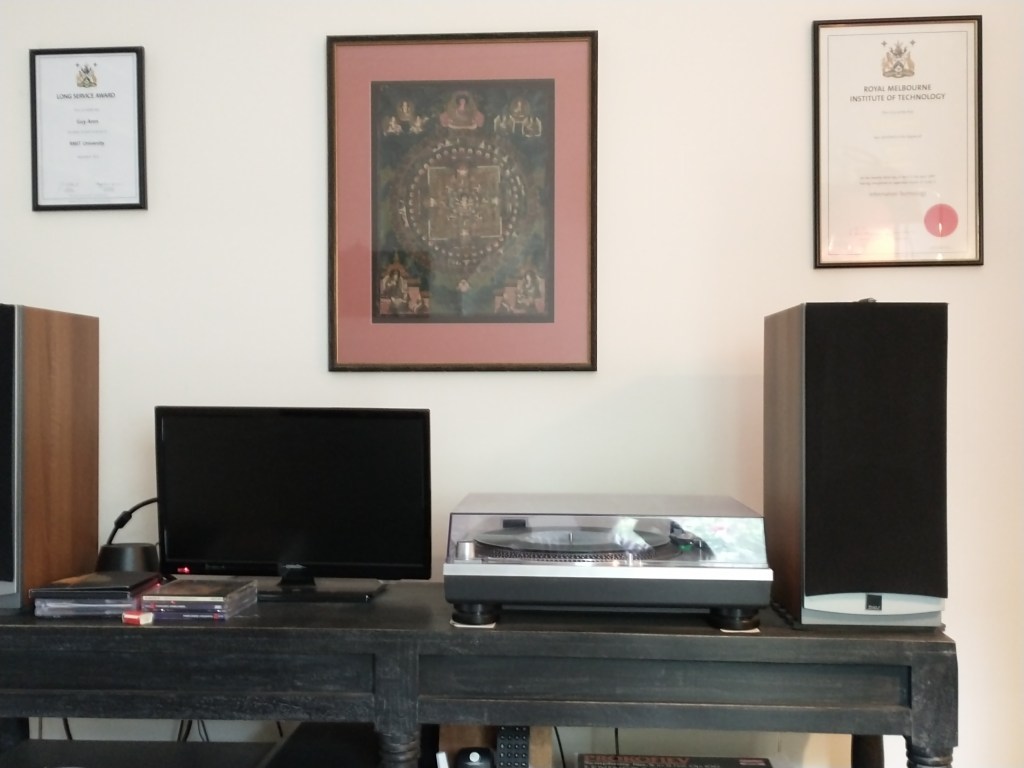
Study

Of course I mucked it up slightly in the execution — measure once, cut twice, and all that. (Not saying where!) But eventually I think it was quite successful. Oddly, from this slight angle, there is a slight optical illusion that makes the large picture look a tad higher than the others. From where I am sitting it actually looks a bit lower. I can tell you they are the same distance apart, however they might look in the picture! Anyway, it is “rough enough for the bush”. More importantly, it has the elusive WAF (Wife Approval Factor). This is no small thing from someone I have been known to refer to affectionately as Der Fisch — as in, an eye like a dead fish! (This is meant to be complimentary: I can’t understand why it is not always so taken.)

The teabag challenge

I generally don’t include video or any other links in blog posts. However, I am making an exception with this clip because it is really fun — even if you’re not normally into this sort of thing! The Teabag Challenge is a 58 second video clip (.mp4) showing a rather nifty bit of heavy vehicle driving. (I think the truck featured is a B-double: maybe someone could confirm or correct this? You know who you are.)

Here is the link to a YouTube copy of the file. (It will open a 15 second ad at the beginning, but you can skip this.)

Marching on

I had my appointment with Dr P this morning. The PSA has gone up slightly again — to 4.8 from 3.7. However, the scans I had on Monday didn’t reveal any new activity. So I am still radiologically in remission. Dr P said there was a spot on my chest which was probably causing the increase in the PSA. (On the way home I checked the list of metastases, or “spots” in doctor-speak, that he gave me in February, 2019. This showed one on the sternum — this is probably the one he was referring to this morning.) Dr P referred me to a radiation oncologist for stereotactic treatment of that spot; I will be having this treatment starting on the 23rd.

(I had stereotactic radiation treatment a few years ago — after the operation and before the chemo/hormone treatment. So it is quite familiar. All these treatments are pretty refined, and fortunately don’t seem to cause me many side effects.)

Anyway, Dr P is not worried about the blood test and scan results — “not even close” were his exact words. I am certainly still feeling fine. The sleep continues to improve, and this always makes me feel better. I will continue with the exercise classes twice a week. (Ditto with the hormone treatment unless and until I need a different one.) I had another Zolodex implant after the appointment with Dr P. After that we had a coffee on Maling Road, and I went to the greengrocers.

The day went a bit pear-shaped after we got home, though. I should explain, for those who haven’t been to our place, we are in the rear unit of two. Another pair of units is directly to the north of us. As we approached our place, we saw a police car on the nature strip and a fire truck and an SES truck in the street. As we passed the units beside us, my beloved glanced up their driveway and exclaimed “Oh, my God!”. A car was sitting in their driveway at right angles to the boundary fence. When we got up to our driveway, the car belonging to the neighbour in the front unit was parked outside our garage. This was all highly unusual!

We asked one of the coppers what was going on. Apparently someone in one of the units to the north of us, while driving out of their garage, had lost control and gone through the boundary fence. This had flattened a section of the fence, and knocked a hole in the garage of the front unit on our side. (This was why the neighbour’s car was outside our garage.)

Our garage has a party wall with that of the front unit. The police and SES therefore asked to check inside our garage to see if it too was damaged. There was a small crack in our garage wall, but no other visible damage. As a precaution, though, the SES put a prop inside our garage to reinforce the roof where it joins our neighbour’s. The latter went to the trouble of tying up the prop to prevent it from falling onto our car, should the wall shift. (They were very concerned that they get this prop back — I assured them I would keep an eye on it. I reckon if the prop fell on the Camry, we would be up for a new car — they are hefty pieces of kit!) Our neighbour’s garage is quite badly damaged — one can see straight through the wall where the impact occurred. She will have to leave her car in the street for the time being. It was just lucky no-one was hurt.

Everyone was very calm and pleasant. One of the police helped me drag some stuff out of the garage to let the SES put the prop in. The police also helpfully supplied us with the contact details belonging to the driver of the car. Armed with this information we rang our insurance company and explained what had happened. They will be sending out someone to assess the damage to our wall in the next few days. No-one actually said “You can go on parking your car in the garage”, but we inferred that this was a fair thing to do while we are waiting for any remedial work that might be required. TBC!

Very nice what there was of it

Well, it has been quite some fortnight.

Not last Thursday but the one before, I had exercise class as usual at 11.30. My beloved came to lunch afterwards with a couple of the guys. After this I drove us to the first in-person meeting of our book group at 2.00 pm. The latter was a rather sombre affair in that we were all masked, and spread out around a large U-shaped table. Afternoon tea, which used to follow the meeting, was cancelled on health grounds. In spite of these rather no-fun aspects, and the fact that most people (including me) hated the most recent book, it was a really good discussion.

The real drawback was that the book kit for the March meeting was not waiting for us at the library as usual. Meetings of the book group take place at a community centre, which also houses a branch of the library service. Normally, at each meeting, someone picks up next month’s books before each meeting. These copies can then be distributed at the meeting. The fact that this arrangement had fallen through made the distribution of the March book much more of a hassle — see below.

The day or so after the meeting the book kit was sent to the branch, whence I collected it. I had hoped that group members could pick up their copy individually, but this wasn’t possible. Book group kits are only loaned out in one transaction to the authorised person, i.e. me. Rather than make everyone come to our place to pick up their copy, I undertook to distribute them all the following week. I notified everyone of the date and approximate time of the the drop-off. When the appointed day rolled around I entered everyone’s address in the satnav of the GT, and set off on a mini-trek around the eastern suburbs of Melbourne.

It was a hot day again — thankfully, the air conditioning was working fine. The satnav turned out to have a handy feature by which one could sort addresses by their distance from one’s current location. This made dropping the copies off considerably more efficient. Even so, with Melbourne’s traffic, it took a few hours to distribute eight copies. I did stop for a chocolate ice-cream at mid-morning. This turned out to be a very generously-filled single cone, and gave me quite a boost. All except one person was at home, and everyone was thankful for the delivery. (I should add that my beloved, and another group member, had gone through the same exercise a couple of times last year.) Everyone just hopes normal service resumes from the March meeting onwards.

The following Sunday was a 4.00 pm performance of Das Rheingold, at the Capitol Theatre in Melbourne. This was the first opera that had been staged in Melbourne since lockdown began last March or so. (I crossed my fingers when I booked the tickets for this late last year.) Good on Melbourne Opera for giving it a red-hot go! For anyone interested, they are planning to do the whole Ring cycle over the next four years. After the performance, one of my oldest buddies (a fellow Wagner tragic), my beloved and I repaired to Southgate for a Chinese feed. Like the opera, this repast had a strong finish, in the form of deep-fried ice-cream. I think I have eaten more ice-cream in the last seven days than I did during the whole of 2020!

The only downside of the outing was that, on our way home, the headlights of the faithful Camry seemed occasionally to go a bit dim. I dropped it off at the garage the following week for a checkup. This found a fault with the alternator, requiring a replacement unit to be fitted. Given that the car is 17 years old, one has to expect that things will need replacing from time to time. Fortunately, this operation will not be affected by the latest lockdown — garages are considered an essential service. I am just glad that these two excursions are all done and dusted before we are all confined to barracks again.

This morning I awoke a bit before seven — a real lie-in for me. We were running short of some essential supplies, so I grabbed a coffee and a piece of toast, and whizzed out to the supermarket. This turned out to be a good time to go — there were only a few cars in the car park when I arrived. Some shelves looked a bit depleted, but not many. Everyone knows the drill by now! Keep calm and go shopping — in whatever form this exercise is possible.

Post for 23 November 2020

I am pretty tired after an eventful morning, so I am just going to write the basics.

I saw Phillip P, my oncologist, this morning. The PSA has gone up slightly, now 1.4. (The previous reading was 0.5.) He said it is still very low, he is happy with how I am travelling at present, and that I shouldn’t worry. He is focused less on the quantum of the PSA than on the trajectory of the rise. A steep increase would be concerning, but a gentle increase like this is not. Nevertheless, he wrote me a referral for a couple of scans (CT and bone) to be conducted before our next appointment. These will reveal if there is any spread of the disease.

(After I came home from a walk this afternoon, I got a call from the scanning centre at Epworth Eastern. The scans are booked for 17 December. It is a convenient location in Box Hill, being where I go for the Zolodex implants. Speaking of which, the next consult with Dr P, and the next Zolodex, are booked in for 23rd of December. This is a bit better than the original appointment, which was scheduled for the 30th of that month. There are lots of places at which I would prefer to celebrate my birthday than a day oncology centre!)

Dr P was running quite behind, and I had a consult booked also later that morning with my GP. I did make the latter on time. Unfortunately, it was a bit jarring. After having discussed a few alternatives for sleeping tablets, he wrote me a couple of prescriptions for some new ones. I quizzed him to make sure I understood how I was to take them — alternating one with the other, or both at once — the latter was the case.

He then said I had had my fifteen minutes and I couldn’t have any more time. If I had further things on my list (which I did), I should have outlined them at the start. I did get one more prescription out of him, for the blood pressure medication. Anyway, I will be changing GPs. I get that medicos are stressed. They need to manage that stress, though, in ways that don’t involve taking it out on their patients.

Positive points to the day included sitting down in a cafe for a coffee after the GP consult — I needed a lift by then! Another was going to the local library, picking up my hold, and taking out a few other books as well. These were both things I had missed doing for most of this year (cafes and libraries having been closed in Melbourne). Op shops have re-opened as well, so things are really getting back to normal.

Last night I took out a monthly subscription to Netflix. This will allow us to watch some more episodes of Emily in Paris, previously mentioned, and a favourite of my beloved. We will also be able to bring ourselves up to date with The Crown. The Netflix Android app works well with the Chromecast, and we were able to switch on the closed captioning without difficulty. One can just renew the subscription monthly. Entertainment is welcome at present, particularly in the leadup to The Festering Season (as I grumpily think of it).

Broken out and washed up

My beloved and I returned on Thursday from a couple of nights away, which we spent in Daylesford.

The end of lockdown has brought an exodus from Melbourne into country Victoria. I wasn’t sure that we would get anything in the rush, even though we were going mid-week. We ended up with a place called Lake Orchard Villas. The main draw with this property was its location, walking distance from the lake. You could also, theoretically, walk to restaurants and shops on Vincent Street. This would have involved a couple of fair size hills, though, so I have to ‘fess up — we drove.

The villa had two bedrooms, a spa bath, and a kitchen. The last was essential in allowing us to make breakfast for my beloved, ensuring that she got at least one “safe” meal a day. Being weatherboard, it was all very charming in a Chekhovian sort of way. The only really startling thing was a whistling kettle. (The first time I boiled it, I thought I had set off a fire alarm.) There was even a bowl of chocolates, of which I had one. One could sit on a little balcony out the front, and there was a bigger area at the rear with a barbecue and a large dining table. We are planning to go again, when I will definitely be looking to fire up the BBQ one evening.

An unexpected feature of the place was Netflix. We watched several episodes of Emily in Paris, a rather anodyne series about a young American woman suddenly sent to Paris for her work. The whole thing is really an excuse for some gentle cross-cultural comedy, and to show off the leading lady’s wardrobe. (That of her boss, with whom she has a fractious relationship, isn’t bad either.) It is all quite fun and totally undemanding — just the thing for a holiday.

We returned on Thursday via Clunes and Ballarat (where a modest-looking restaurant yielded a cracking Chinese meal). The next day the dishwasher people arrived (early) to put in the new dishwasher. I had been a tad nervous about this. Old dishwashers tend to leak: if the guys removed the old one through our place, I could see the carpet getting stained. Fortunately they had a trolley with soft tyres, allowing the appliances to be brought in and taken out via the courtyard. Once up the steps, everything happened on a tiled floor.

The installation was mostly uneventful. The old dishwasher had started leaking, and this moisture was mopped up by the installers before putting in the new appliance. Dishwashers sit on adjustable feet; if these are jacked up, the gap which this creates underneath is hidden by a kick plate. The Siemens was not quite as high than the old Dishlex, so I had to choose between having a noticeable gap at the top (between the dishwasher and the underneath of the bench) or a bigger one underneath it. I chose to even them out and have some gap top and bottom. The new kick plate is a lot more recessed than the old one, and this exposes a grout line in the floor tiling that we had never seen before.

The kitchen floor is tiled in a diamond pattern. Underneath the cabinets, for some reason, this changes to a square grid pattern. The grout line from the second pattern is what is now exposed, along with a gap of 1.5 cm or so underneath the dishwasher. It is possible to have the old kickplate trimmed and fitted back underneath the dishwasher. That will mean that it matches the cabinet underneath the sink, but not the dishwasher door (which is stainless steel). Anyway, all these things can be fiddled with at our leisure. The installers ran a test load, and the Siemens is certainly incredibly quiet compared to the Dishlex, which used to groan, gurgle, and thump away.

I had a bad moment reading the warranty leaflet, which mentioned a factory warranty of two years. This was a surprise, as the store had advertised a five year warranty for this brand. I got on the blower to the salesman, who knew straightaway what I was ringing about. The leaflets are printed overseas, and reflect the warranty offered in other places. Siemens dishwashers in Australia have a five year warranty. He sent me an email to this effect so that I had it in writing.

Having taken what will probably be the last trip in the Camry, I read with interest a road test of a Mercedes Benz GLC 300 PHEV. (PHEV, as you will no doubt know, is a plug in hybrid electric vehicle.) This was the same model that we had hired over a year ago when I won sixth prize (!) in the 3MBS-FM radiothon. (That one, though, had a diesel engine.) The GLC is a big vehicle, to be sure, but I really enjoyed punting it around the Dandenongs for a day. $80,000-odd is out of our range, though, so we will probably end up with another Camry. The last one is still going strong after sixteen years, just getting a bit elderly and cranky — like one of its owners.

Rest & recovery

When I started writing this post, I was trying to remember when I had had the hernia operation. According to an email message in my inbox, this took place on 9 October. I came home the following day. By now I am therefore well past the four week mark in my recovery. According to what the nurse told me, I have a couple of weeks to go.

The wound site was never really painful, and over the last few weeks has become gradually much less sensitive. It was always a bit worse in the evenings, when I generally felt more crummy. Now I am only conscious of the wound if I do something it doesn’t like. Yesterday was one of those days.

Sweeping the courtyard was one of the jobs I had been putting off. This procrastination isn’t unusual for me, but in this case I was conscious of all the bending down this job would involve. (Bending from the waist is better for me at the moment, as it puts less strain on the wound site.) By now, though, I thought that I could probably handle a little task like this. Sweeping the courtyard always makes it look neater and more inviting. Afterwards, I pictured myself sitting out there in the shade of the umbrella, enjoying my handiwork.

This was pretty much how it transpired. The sweeping, picking up all the debris into the big garden bag, putting some of that into the compost, and the rest into the green waste bin, all took about an hour. Along the way I re-fixed some shade cloth I have rigged up over the daphne in the front garden. I interspersed these with hanging out a couple of loads of washing, including the towels. (All these little tasks took me over my step target for the day, without having gone past the mailbox.)

I did notice the hernia wound after a while. It wasn’t painful exactly — just enough for me to think, okay, that’s about as much as I can manage right now. But I enjoyed being outside, getting things looking a bit better, and having a closer look at the garden.

The main problem I’ve had over the last few weeks has been my sleep. I think this has to do, at least in part, with my not being able to exercise as much as before the operation. (I did resume a modified exercise class just last week.) Consequently I have been getting, on average, an hour and ten minutes less sleep than I was having before the operation. I have also been waking several times a night, and getting up in search of something that will knock me out for a while. So the sleep has been both shorter and more fragmented.

The other reason is to do with my sleep medication (Stilnox), to which I have been gradually becoming habituated over the years. I really need a new one. Whatever I take, however, has to not interfere with the Zolodex — while I remain on that treatment. I will be seeing Dr P on Monday week to discuss all this, together with my most recent blood test.

I have had insomnia for about 25 years now. Over this time I tried most of the sleep treatments around. None delivered a cure, so I just learned to live with it. The last four weeks has been an extremely sustained patch of sleep deprivation, however, and I have been finding it pretty tough. I hope that gradually getting back to my full exercise program will help.

I am also going to investigate contactless shopping for groceries. In this scenario, I drive to the supermarket, open the boot of the GT, and send a text to the effect of “I’m here”. Someone will put the bags into the boot of my car, I drive home, and at this point my beloved will bring the bags inside. This way I will get a mini-outing, and she will have the chance to catch up on her work a tad. From each according to his ability, to each according to her need.

We did some old-style shopping over the weekend. Our dishwasher packed it in last week. (I think the noisy, thrashy thing is about 20 years old.) I read lots of reviews, and measured the recess in which it sits under the kitchen bench several times. Yesterday we headed to one of the nearby big box stores to kick some tyres. Did we want a two or a five year warranty? Would a cutlery drawer be a good thing, or would we make do with a basket? All the alternatives were worked through, and we chose a German make with which to replace the tired old Dishlex. The credit card was unfurled to good effect, and the new dishwasher — a Siemens — is being delivered on Friday.

In the meantime, my beloved and I have had some slightly nostalgic times handwashing our dishes, and drying them with a tea towel. I seem to remember Mum and Dad having sotto voce arguments while doing this. Like them, we have fallen into gender roles — my beloved washing, me drying up. We haven’t had any arguments so far, though, even when I queried her practice of putting the cutlery into the sink first. I will remain a cutlery-last man to the end of my days! (I hope this preference will soon revert to being a theoretical one.)

Kleines bissen

As all of you know, Kleines bissen are just “little bites”. (OK, you do now.) Mozart lovers will recognise a near relative of the adjective “Kleine” from the title of his most done-to-death piece, Eine Kleine Nachtmusik, K525. Anyway, those still reading by now are way ahead of me — this post is just bits and pieces.

I don’t know if John Silvester’s article Just hang on: the A to Z of pandemic politics appeared anywhere other than in The Age. If you haven’t read it, please do forthwith. I laughed so much that I literally (not virtually) had to wipe my eyes. Twice. It was both extremely funny and slightly sobering: the latter because nothing in it was either invented or exaggerated.

I had a small win a day or so ago. My vintage FM radio tuner had difficulty receiving ABC Classic. I listen to the radio a lot, so this was what polite people call a PITA. Trouble receiving ABC Classic was unusual, though; this station has a strong signal. I cursed extensively, and looked up where I could get a decent new tuner. The prices of possible replacements gave me pause. Maybe I should go for digital radio or streaming radio instead. These would present fewer problems with reception; unfortunately, to me, they sound processed and harsh.

My research, however, turned up a couple of simple things that could improve my FM reception: elevating the antenna, and moving it nearer a window. The antenna was already up on top of a cabinet, about 1.5 metres above the floor. The second suggestion seemed a good idea, though; what was to lose?

I needed a longer coaxial leads. Generally long runs of cable are not a good idea because they increase the potential for interference. I decided to give it a crack anyway. Fortunately, I had several coax leads down in the garage. The longest one turned out to be a monster; maybe 10 metres. The hernia wound was feeling pretty good, so I went through the steps necessary to disconnect the antenna, move it closer to the window, arrange the new cable around the corner of the study, and re-connect everything. Take ‘er away, Boris!

Well — my little Technics tuner sounded pretty happy with a lot more signal to munch on! 3MBS-FM was particularly improved. My antenna has a gain dial, giving some variable boost to the reception. When I moved the tuner dial to 3MBS, and boosted the gain on the antenna, I could see the signal strength meter zoom up from 4-5 to 8-9 — just about the max. (Not being a Marshall, it doesn’t go up to 11.) The stronger signal significantly reduced the hiss, as well. ABC Classic was similarly improved. Cost: 0$.

I came across a story in the Green Guide, I think, about a TV show showing celebrities reorganising their closets. Caviar to the general, perhaps. However, my beloved is very interested in a) fashion and b) closets. (Her wardrobe is organized to a T.) I therefore adjudged this story to be of strong potential interest to her. Her tablet needed charging, so I gave her mine on which to read the story. Being unused to my device, in attempting to scroll down, she accidentally opened an image. I reached over helpfully (not to say patronisingly, even patriarchally) to close the image for her. My hand was swiftly batted away. The moral — never get between a fashion maven and a fashion story!

Avoiding the past

Last night we just finished watching the Watergate series that has been recently broadcast on SBS. Watergate started really coming to a head in 1972, the year in which I sat the Higher School Certificate. So you would expect that something that happened nearly fifty years ago would be of mostly historical interest. However, we found this recounting of it both extremely gripping, and highly relevant to the current US political scene.

Part of the interest of this series was its use of dramatised episodes. (The dialogue of these was taken verbatim from the famous Watergate tapes. ) These episodes demonstrated something we only knew intellectually: real people had said these things. Everyone involved, especially Nixon, was prepared to engage in endless acts of denial and deception, to stop the truth coming out. The scale of the cover-up was so vast, it was difficult to keep track of everyone involved. Hundreds of people (including the Attorney General), federal government agencies, the shadowy Committee to Re-Elect the President, elements of the Republican Party: all were recruited to keep a lid on things. Later on judges, standing committees of the legislature, and specially commissioned Watergate prosecutors, each with their small army of investigators, got involved.

(Incidentally, when people speculate about Trump refusing to accept the results of the upcoming election, and attempting to mount a coup, this was also on people’s minds just before Nixon’s resignation. The word was put out to army command that they were to disobey any order from the President to surround the White House with armed troops. One of the investigators said dryly that, if General Haig — then the White House Chief of Staff — turned up wearing his uniform, everyone should watch out! Fortunately, Al Haig is best remembered nowadays for offences against the English language, the most splendid of which was surely “Let me caveat that response”.)

We can all be thankful that investigative journalists had smelled a rat from the beginning. Bob Woodward and Carl Bernstein of the Washington Post spent the most time on it initially. Their persistence led more and more of the story to be exposed, and its multifarious connections revealed. The grilling that their colleagues in the broadcast media, most famously Dan Rather, continued to give Nixon and his parade of press secretaries added significantly to the pressure. All these reporters (and their proprietors) withstood repeated stonewalling and intimidation intended to throw them off the scent. At the end of it all, a President was revealed to have disgraced his office and the Constitution that he had sworn — twice — to uphold.

Watergate provides an compelling background to the current attempts to make Google and Facebook pay, effectively, a levy to news originators such as Nine Entertainment Co., News Corporation, and The Guardian. (This story from The Guardian explains the rationale behind the draft legislation under which — if it becomes law — these payments will be made.)

In my view, Google and Facebook are acting in a completely parasitic way towards news originators like those listed above. The social media companies do not employ journalists, maintain newsrooms, subscribe to Reuters or any of the other news services, or write news stories. They just repackage what other people do.

This would not matter if Google and Facebook were not eating the news providers’ lunch in the digital advertising market. The story linked above contains an estimate by the ACCC that Google has about a 47% market share of Australian digital advertising (excluding classifieds). I have not seen any suggestion that the pandemic is growing the total digital advertising spend. If it is a zero sum game, these inroads by Google and Facebook represent lost revenue for the news providers on an enormous scale. All of the latter have certainly shed staff and cut back their operations in recent years, not least by the cancellation of local and regional newspapers.

It’s uncomfortable for me ever to line up with NewsCorp (the Voldemort of media companies). The Watergate investigation, however, reminds us that investigative journalism — no matter who does it — is a public good. How else are we, as citizens, voters, and consumers, to know when bad deeds are committed? Good investigative journalism doesn’t come cheap. Can we do without it, though? If the news organisations all shut up shop, are Google and Facebook really going to start shining light into dark corners on our behalf?

Hernia, I’m home!

It’s day four since the operation, and things are improving. The main obstacle to overcome to date has been constipation (not to put too fine a point on it). The surgeon’s practice put me in touch with a nurse, who made a few suggestions. After applying several of these, I think I am back to normal.

I know that certain medications, such as opioids, can exacerbate this problem. Fortunately, I don’t think I will need these meds from now. I’m not having any pain from the wound, which is not looking at all alarming. (I got a page or two of notes about recovery; these have been helpful. Where did we put these things before fridge magnets were invented?) I am seeing Mr B, the surgeon, on Friday. He will look me over and tell me, among other things, when I can resume exercise.

Melbourne is obviously still in Stage 4 of lockdown. Consequently, our book group remains in virtual (or possibly nominal) mode. We could, of course, have a discussion using Zoom. However, there is zero interest in learning this platform, and no-one wants to do the hand-holding required to get people up to speed with it.

The original list of titles that I scientifically selected (in throw-a-dart-at-the-list style) has been honoured more in the breach than in the observation. The book that has turned up this month is an interesting one, however: Furious hours: murder, fraud and the last trial of Harper Lee, by Casey Cep.

Harper Lee might have been the most famous author to be affected by second novel syndrome. The author of To kill a mockingbird became intrigued by the murder in Alabama of a black preacher, the Reverend Willie Maxwell. Lee returned to Alabama to attend the trial of the man accused of this murder.

About 10 years earlier, Truman Capote had enlisted Lee to help him research the murder of a Kansas family. Capote used this research as the basis for his true crime book, In cold blood. This may not have won its author the Pulitzer Prize, but it was nevertheless a huge hit. Lee might have thought to work the Maxwell case up into a similar book. However, the project came to nothing.

The point of writing a book about a book that never left the launch pad may not be obvious. Furious hours might seem like an archival exercise: a hunt through Harper Lee’s laundry lists. It actually tells a fascinating story that is not short of angles. The Reverend Maxwell was accused of murdering several of his family members for insurance money. The man tried for his murder was acquitted in spite of the testimony of many witnesses. The accused’s defense attorney had previously represented Maxwell. Then there are Lee’s attempts to turn all this into a book. Casey Cep organises all these narrative frames in magisterial style. (I don’t wish to carp, but an index would have really put the cherry on top.)