Taking a tumble

I had a small accident on Saturday that has not immobilised me, but has certainly slowed me down a bit.

We had been out for an hour or so to get fruit and vegetables and have a cup of tea down the street. Wen we got home I discovered that I had forgotten to bring my keys, and thus couldn’t take any of the groceries inside. Adding further distraction, my beloved was still in the car taking a call from a friend, who had rung just at a minute earlier. I came down the steps to take my beloved’s keys and let myself in, but, being distracted, missed a step on the way down and tripped on it. I landed on the ground on all fours; fortunately I was nearly at the bottom of the steps, so didn’t fall any great distance. Even so, I ended up with a badly sprained left ankle and a graze to my right knee. (The way I landed at least meant I didn’t injure my hands or wrists at all.)

After we had put the groceries inside, I surveyed the damage. The area under my ankle bone (the lateral malleolus) had swelled up like half a tennis ball, and there was swelling to the foot and ankle generally. Fortunately I had a Velcro elastic bandage which wraps around the ankle joint and under the heel. I put this on (with an ice pack) to give the joint some support and allow the swelling to go down. The pain was not bad as long as I didn’t put weight on the leg.

That afternoon we watched a couple of movies on Netflix and just generally chilled out. I was able to hobble around to some degree, aided by a bamboo walking stick that Jill remembered we had. A couple of things fell into the “fortuitous and fortunate” category. The first: having just done a grocery shop, we had no immediate need to go out. The second is that my next appointment with Dr P, followed by the chemo infusion, isn’t until 16 October; by this time I’ll be more mobile.

It’s now Tuesday, and I’m looking forward to getting out of the house! (I have ventured as far as the bottom of the steps.) Before this I will need to have a sponge bath — I haven’t ventured on a shower yet. (To the suggestion of a shower, I replied “What would I hold onto?”.) Yes, accidents like this have highlit the need for us to install some fall-reducing stuff in our place. A grab handle in each of the showers and a hand rail for the front steps are at the top of the list. (The latter could have saved me the tumble.) Meanwhile I am hobbling around quite well.

Being a good greenie

OK, so we all want to do the right thing with the packaging and so forth that we bring home. But confusion reigns. The War on Waste programs a few years ago (the third season of which was shown on ABC TV in Australia recently) highlighted the lack of clarity at the household level around recycling practices. Are plastics that spring back when you scrunch them up treated differently from those that don’t? What about “recyclable” coffee cups?

Fear not. A recent guide was published in a free online magazine that takes you from the soup to the nuts of household recycling. I printed this out to put on the fridge. Then the thought occurred to me: other people might want to do that too, without the fiddling around that is involved with printing a web page. So, to be a good greenie, I have pasted the text from the original document into a Google Doc, taken out excess line breaks, and added a bit of content. (The guide is in two parts. I haven’t interfiled the new content with the old, so you will just have to live with that.) The new document is unimaginatively called Recycling, and is available here until I get a take-down order.

I’m aware there is a controversy about whether plastics recycling, in particular, is responsible for much of the microplastic pollution currently occurring. I don’t know enough about this to comment. The collapse of the Redcycle plastics recycling scheme has left us, like everyone else, having to put our plastics in the general waste bin, thus eventually into landfill. It is all rather depressing.

We returned a few days ago from two nights in Hepburn Springs. The place we stayed was new to us, and much less expensive than our usual villa in Daylesford. The only negative for the property was that it was on the side of a hill, and thus down about five steps. However, it was very neat, well appointed, and snug inside. We had the facilities for cooking breakfast; this is a must on account of my beloved’s food intolerances. Going midweek was definitely less stressful than on the weekends, when half of Melbourne seems to flock there. Of course we chose to go a few days before the winter solstice, and thus the true depths of winter — down to about two degrees overnight. Melbourne was discernibly warmer!

Centurion

At our last visit to Dr P on 13th November, my PSA had reached 116. We had both been expecting the PSA to continue rising, as it has pretty much every time this year. Having passed the 100 score, however, felt as though a psychological barrier had been breached.

Dr P was quick to remark, as he has all along, “numbers don’t mean anything”. He said the mark he looks for to change course on treatment is when the scores double rapidly, for example, every four weeks. The “change” would involve another course of chemotherapy. He has said before he wouldn’t hesitate to resort to this if he thought it was necessary. In the meantime, though, he is guided primarily by how he considers I am looking and feeling. He commented approvingly I had put on some weight — something that no patient whose cancer is progressing does. My three-monthly CT and full body bone scan is booked in for early December, following which I will be seeing Dr P on December 11th.

Near the end of the last consultation, we worked out that we had been seeing Dr P for six years, which seems unbelievable. At that first meeting he said he wouldn’t sugar coat things, and he has never done that, but he is also careful to accentuate the positive. This is a fine line to tread, but one he has always managed to stick to.

Otherwise I have been having a fair bit of trouble with sciatica, and stiffness and soreness around the sacroiliac region. That joint has been fused after having ankylosing spondylitis in my twenties. (The AS also left me with several fused joints in my neck.) A few treatments from a medical masseur have helped reduce the stiffness. When my chiropractor comes back from her break, I will resume seeing her. I will probably alternate between her and the masseur, as the need arises. A second line of defence is exercise classes, something I have just been too tired to contemplate returning to. However, I saw my exercise physiologist last week, and she gave me the green light to resume classes, albeit with a program adjusted to cater to my current injuries. The sciatica is responding to a fairly high dose of Lyrica (pregabalin). This seems to bring the symptoms down to the point where stretches effectively deal with them — something that stretching alone does not.

Streaming-wise we were mesmerised by David Fincher’s new film The Killer (Netflix). on that platform also we are also enjoying A Murder at the End of The World, which brings several fresh twists to the classic Agatha Christie-style murder mystery. The Icelandic settings are a bonus.

Merkel vol. 2

You will remember, after the sentinel lymph node biopsy, I was to be told the results of this operation. I did hear about this last week, and the CT scan did show some isolated and small Merkel cells in one of the lymph nodes. Consequently my radiation oncologist at Peter Mac, Dr M, has started me on a course of radiation directed at the lymph nodes in the head and neck area. This course will overlap the one which has already started for the upper left eyelid, and will be of about the same duration. Both courses of radiation are now to be administered five days a week, instead of four as previously. The object of this is to shorten the duration of the overall treatment. I now expect to be finished with the lymph node treatment about mid-September. I am not sure exactly when the lymph node treatment will begin — possibly next week. Dr M, who is overseeing both treatments, will try to keep the two appointments as close as possible each day, so we are not hanging around Peter Mac for too long.

As preparation for the lymph node procedure, I had a mask made to cover the entire head and shoulder area. The mask protects areas other than those on which the treatment is focused. It is made of a kind of white plastic mesh. It was first soaked in warm water, then applied over my head. It shrank a bit to fit the contours of my face — a weird sensation, about which I had been warned. While this was in place, I then had a CT scan. Including waiting for one of the assistants to turn up, all this took about an hour. It was followed by the usual radiation session for the upper left eyelid.

The prostate cancer treatment of course is continuing. I have made a mental note to tell Dr M to keep Dr P in the loop about the lymph node business. (Last time I saw Dr P, he knew I had been referred to Peter Mac.) I will be seeing him next Wednesday for my regular monthly consult. In preparation for this, I had a blood test on Monday. Afterwards I repaired to an op shop, handily just across the road from the pathology place, where I have previously found some decent CDs and vinyl. This time I scored a nice cardigan, a sort of ginger or peanut butter colour, and a terrific piece of knitting — very tight, no missing buttons. (From a few hanging strands inside, presumably from where the wool ball had run out, we surmised it had been hand knitted.) Op shops seldom have jumpers that are worth wearing, being either pilly, food stained down the front, or both, so this was a good find.

You should have seen the other bloke

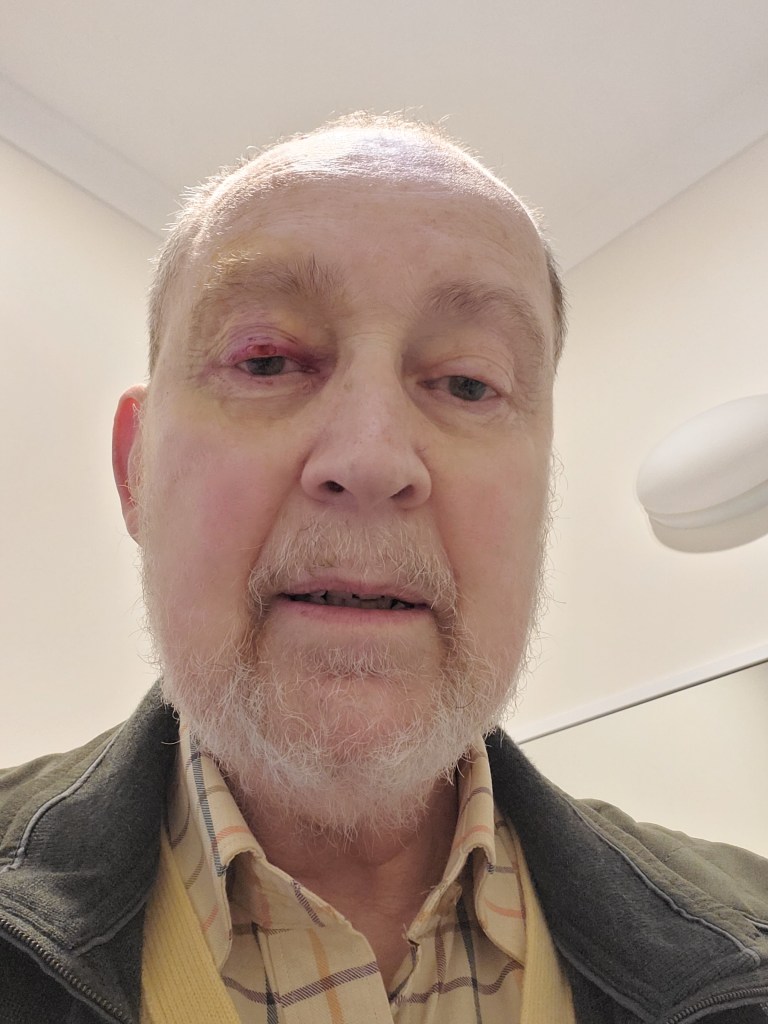
This morning I had a brief operation to remove a small growth on my upper left eyelid. (For some reason, the picture above is reversed; the shiner is definitely above my left eye.) The growth had been detected during my annual eye test. I hadn’t really noticed this; it was blocked by the upper frame of my glasses, and I couldn’t see it when I wasn’t wearing my specs! Anyway, the optometrist recommended that the growth be removed by an opthalmologist.

I saw the specialist to whom the optometrist had referred me, Dr L, last week. He said it probably wasn’t cancerous, but that pathology tests would confirm this. If it turned out to be, he would need to take out a bit more. (The plus side is, in that instance, my health fund would pay a rebate for the first operation!)

My original appointment at the eye clinic was for 10.45 this morning, but they rang about 9.15 and asked if I could come in earlier (they had had a cancellation). This suited me and my beloved, who was to drop me off there and pick me up afterwards. (This was necessary because I was to have a local anaesthetic and eye drops.) Anyway, we beetled off there about 9.30. After an extensive induction and history-taking (all of which had taken place at the earlier consult), an anaesthetist gave me a local and some other shot to reduce any anxiety I might have, and Dr L speedily removed the growth in the clinic’s theatre.

I had had to fast this morning, so was glad to have a couple of cups of tea afterwards — they didn’t run to real coffee — and a sandwich. The only real holdup came when exiting the practice.

The building is situated on sloping land, with a small concreted area of outside the front door, clearly intended for short-term pickups and dropoffs. There is a narrow driveway running downhill to the right of the building, which leads to the practice car park. Because of the slope of the land, however, patients entering the practice from the car park need to climb quite a steep metal staircase, which has a right angle bend in it. The nurse therefore directed me to tell my beloved to park on the concreted area outside the front door, so I could exit without going down the staircase to the car park. (I had a patch over the left eye at this stage, and was still feeling the effects of the anaesthetic. These things would have affected my depth perception and so on.)

The problem with this sound advice was that there was already a car parked on the concreted area outside the front entrance. My beloved therefore went down the driveway, heading for the car park. She couldn’t even park there, however, because she was blocked by a truck making a delivery! Regardless, the nurse was adamant I couldn’t walk down the staircase, even with assistance. Of course they couldn’t have prevented me if I’d insisted, as I was on the verge of doing. (I just wanted to get out of there at this stage.) Anyway, my beloved drove around the block and parked behind the illegally parked car. I resisted the urge to let down its tyres as I made my exit. (Had I had my wits about me, I would have keyed one of its doors — I was pretty cross that its owner was being so selfish.)

Anyway, all is done now. My beloved reckons I look as if I’ve been in a fight, I’ve resisted giving way to my anti-social urges, and am being waited on like Lord Muck. For a while I even looked like the Whitmont Man!

Not taking sides — updated

*******************************************

I gather there were some issues with people not being able to see the previous version of this post. Apos for that! I had restricted the access condition to subscribers, naively imagining that my readers mostly had a subscription. Some do, but have difficulties opening posts. I have taken this up with WordPress, but not gotten very far. I have definitely changed the setting on this updated post to Access: Everyone. People who get the alert, but can’t see the whole post, could try refreshing their browser.

Anyway, I am putting this update at the head of the post, so people who could read the content previously posted don’t have to scroll through it again. I previously discovered that the channels on the turntable were hooked up incorrectly, in the sense that the right hand channel was actually the left, and vice versa. Then I wondered whether I was having the same problem with my disc player. It wasn’t easy to determine, because I didn’t have a stereo check CD or DVD. However, the player (a Cambridge Audio) has a fairly primitive YouTube browser built in. So I found a stereo check video and played it back. This was basic in the extreme, consisting of someone reciting “Left channel, left channel, left channel”, then “Right channel, right channel, right channel”. (The sound was put through the correct stereo channel alternately, obvs.) Anyway, it showed me that each channel is coming through the correct speaker. Here endeth the update.

*******************************************

Warning — ultra nerdy content ahead.

I had an interesting trawl through my local op shop yesterday, coming back with three DVDs and two LPs. We watched one of the DVDs last night, quite an interesting 2007 “neo-noir psychological thriller”, Disturbia . A good mid-week flick, featuring a breakout role for Shia LaBeouf. (The other discs I haven’t seen yet.) I regard op shop DVDs as a cheap indefinite loan. For convenience I have the region settings of the Blu-ray recorder in my phone, so I don’t end up buying something I can’t play.

The vinyl was pretty interesting. The first one I played was Vangelis’ sound track to Chariots of Fire. (Not going to link this, you’ve all seen it!) Side 1 comprised various tracks from the movie sound track, all played by the monomynous Vangelis, except for the original choral version of “Jerusalem”, by Hubert Parry. (This must also have featured in the sound track — it was so long ago that I saw it, I really don’t remember.) Side B was a kind of fantasia on the main Chariots of Fire theme, played on various keyboard instruments also by Vangelis. This was all quite a blast from the past, and a very well produced LP.

The second one was quite an ear opener. This was a demonstration disc called “Miracle in Sound: the Festival Stereo Sampler” (Festival Records, SFL-2/1). Strangely, this is an Australian label, although the content originates in the US. Side 1 began with a follow-the-bouncing-ball track, intended to show whether your speakers are set up with the correct left to right orientation and phase. A bouncing ping pong ball sounded first out of the left, then the right channel. Following this, the bouncing ball is heard alternately left and right. Finally, the ball appears to be bouncing in both channels simultaneously, to allow one to hear the elusive “middle channel”.

I have had stereos since the 1970s, when vinyl and cassettes were all there was. I used to have about 300 records, most of which I gave to 3MBS-FM. However, the vintage Luxman tube pre-amplifier I bought about seven years ago has a very good phono stage. This has encouraged me to start collecting vinyl again. Well, when I played “Miracle in Sound”, I was glad I was sitting down! My speakers were reversed — for the turntable, at least. What I had thought was the left channel was actually the right, and vice versa. This is totally a rookie error, which I couldn’t believe I had made. Still less, having made it, that I hadn’t noticed it! Que?

Something that made the reversal harder to pick up was that the balance control worked correctly, i.e. when turning the knob to the left, sound was transferred to that channel, and vice versa. My stereo also is hellaciously complicated to set up. This is because it has not only a separate power amplifier and pre-amplifier, but also a powered subwoofer. My valve amplifier guru Dallas drew me a diagram to aid me in which leads have to hook up to what. Physical access is quite complicated also, with little room to get behind everything and check. So the possibility that, at some point, I swapped over some leads is quite a real one.

There is a subtler extenuating factor, if you like, to do to with orchestral layout. Growing up and going to concerts in Australia, one might think that orchestras are always sitting with first fiddles on the conductor’s left hand, followed (reading left to right) by second fiddles, violas, and cellos. Second and third tiers are woodwinds and brasses, with double basses behind the cellos. Percussion at the back. Well, after looking at maybe a hundred Berlin Philharmonic concerts (on their Digital Concert Hall service), I can tell you, their string sections sit quite differently. First fiddles on conductor’s left (same as here), but then violas and cellos next to them, then second fiddles on conductor’s right. Alternatively, the violas can swap with the second fiddles. Double basses can be behind the first fiddles in the second tier, on the conductor’s left, or in the middle. It all depends. All these seating arrangements affect the sound stage; otherwise, I might have realised something was wrong earlier.

Fortunately the pre-amp has a nifty feature — a “Reverse Stereo” switch. This swaps around the channels left to right, without having to touch any wires. Everything suddenly sounded as I imagined it should! Simple. Except that now I have to figure out whether the outputs from my my disc player are reversed left-to-right as well. If so, when I am going from playing a record to a CD or DVD, I have to remember to un-reverse the channel reversal. Hifi paranoia, here we come!

PS Please, no advice to ditch the stereo for something simpler! If I didn’t have this to fiddle with, what would I do?

TV or not TV

I recently stumbled across the title of a book that I read, then lost track of: Bowling alone, by Robert D. Putnam (Simon & Schuster, 2000). The author, professor of Public Policy at Harvard University’s John F. Kennedy School of Government, was exploring the phenomenon of the decline in social capital since the 1950s. By “social capital” Putnam meant the participation of Americans in social institutions by standing for public office, and joining political parties or trade unions, religious groups, parent–teacher associations, veterans’ organisations, volunteers with Boy Scouts and the Red Cross, and service clubs such as Rotary. People are now less prepared to join these groups than was the case in the post-war decades. The level of trust they express in governments and social institutions generally has also declined.

I don’t doubt that this trend was a general one. In my childhood in Darwin, I remember my parents going to card nights, singalongs around the piano, and picnics with friends. OK, Darwin was a pretty small place then. The past is a foreign country, as L P Hartley observed. If you lived in Darwin in the 1960s and had a family, you mostly made your own fun. But when we moved to Sydney, my parents stopped participating in most of these forms of socialising. Of course they knew many fewer people there. Sydney offered substitutes, however, such as the Mensa organisation, which would probably not have been an option in Darwin. Joining this gave my father the opportunity to organise bridge and chess games at our place. There was also TV.

Why have overall levels of sociability and trust receded from their high in the decades immediately following WWII? Putnam attributes these phenomena primarily to the increasing prevalence of television and other electronic forms of entertainment. Other factors included the increasing participation of women in paid employment, and the effects of suburbanization, commuting, and urban sprawl. (I have cribbed these and other details from the Wikipedia article about Bowling Alone.) It all might sound rather dry, but Putnam, as I recall, is a graceful writer. As one might expect, his conclusions are all well buttressed with survey and other data, and his book has a substantial bibliography. It made quite an impression on me when I read it, so I was glad to be reminded of its title.

Independently of this, I had been thinking about television and the tremendous ways in which it has evolved. This was particularly clear to me, given that Darwin in the 1960s did not have TV. (The fun I had to make there included playing records and listening to Tarzan serials on our Kreisler radiogram.) I first saw TV in Brisbane during a family holiday to Queensland in the 1960s. I found it entrancing. As soon as we returned to our accommodation, I would switch the set on, regardless of what was being broadcast. The medium was truly the message.

TV then of course was black and white, and limited to a handful of channels. My beloved grew up in a regional area where there were two channels — the ABC and a commercial. She became an authority on the programming available at any given time of day or night. Before programs were shown, at 8.00 or 9.00 in the morning, the test pattern was broadcast. The evening’s viewing always concluded with the Union Jack rippling in the breeze, to the strains of God Save the Queen. (I’m sure some people would have stood up at home while this was playing. When writing this, I was curious about whether this had actually been a thing. All I could find was a story about how the Mission Barbecue chain in the US plays The Star-Spangled Banner at 12 noon, at which patrons may stand, doubtless with the encouragement of some of their fellows.)

A former housemate of mine referred to a female life partner as “she with whom one watches TV”. During the thousands of hours of TV I have watched with my beloved, we have gone from her flickering old black and white set, to a hulking Philips colour cathode ray TV that I lugged around to three domiciles, to our current Panasonic flat screen. We had the Philips CRTV for about 16 years. it had the boxy 4:3 aspect ratio; when digital channels came in, it required a set-top box to receive them. When we bought our place in Burwood in 2014, I refused to move this heavy old relic one more time, and bought the wide screen Panasonic from a Dick Smith store — back when these places still existed.

Our previous place, in Camberwell, had ushered us into the era of the second TV. The first of these was a tiny set, purchased in about 2013, which had a screen about the size of a microwave oven door. This tiddler went originally to the sunroom of our house in Camberwell, then to the study of our current place in Burwood. It gave up the ghost (no pun intended) just a few weeks ago. I replaced it with a much bigger Blaupunkt set, purchased in a Coles supermarket for $210. (Only a few TV manufacturers make their own screens, so a no-name TV will probably work as well as a recognised brand, and certainly last as long.)

When we bought our first VCR, this ushered in the era of time-shift programming, a.k.a taping off-air. The Green Guide insert in Thursday’s The Age lists the TV programs for the week. It became a ritual to go through the Green Guide and set up the following week’s programs to record. This could be a delicate operation: allowance had to be made for programs which started early and finished late. The commercial stations were the worst for running behind time, particularly when the programs had been preceded by a football match, charity broadcast, or other program likely to run over time. Much unhappiness was expressed when once (once!) I failed to sufficiently “pad” the end time of a recording of Cold Feet. Consequently the precious last few minutes of an episode were missing in action. (Of course this was the exception which proved the rule. On a very few of those occasions, too numerous to mention, when we had been able to watch the entirety of a program, I allowed myself to point this out. This did not prevent some good helpings of hot tongue and cold shoulder from coming my way after the initial offence.)

Other pinch points occurred with taping off-air. The early machines had a limited capacity to record, so when multiple programs earmarked for off-air recording overlapped each other, some bargaining had to be engaged in to pick a winner. The VCR could not record while a program was being played back. Thus when we were playing something back, and the VCR began setting itself up to record a second program, the playback had to be suspended until the recording of the latter had been completed. Our current hard drive recorder allows not only the recording of three programs at once, but also playing one of these back while it is still recording. Better still, it records closed captions. A program broadcast over several episodes, such as a series, can be set up to record in one go, and will stop recording when the series is completed.

Despite all these refinements, our current HDD recorder will probably be our last. I still engage in the weekly ritual of setting up programs to record. Each time yields fewer noteworthy offerings, however, to the point where it has become bit of a waste of time. The streaming services have such a wealth of content that I can’t remember when we watched something on a free-to-air channel. Like everything, this has its advantages as well as drawbacks. On our recent trip to Singapore, we found the TV set in our hotel room had none of the streaming services we watch at home. Fortunately, I had installed the apps for these services on my Samsung tablet. The TV in our room, also fortunately a Samsung, had a feature called screen mirroring. Using that I was able to first tune into Netflix on the tablet, then mirror the tablet screen on the TV — including captions. The broadcast could be paused and continued at will. None of this would have been possible before the advent of wifi, streaming television services, et al . (Perhaps my rigging up this Rube Goldberg arrangement restored a few brownie points, after having cut off Cold Feet, as it were, many years previously.)

Streaming brings a torrent of content to our living room. It can also split us into electronic tribes. When free to air TV was all there was, at least this provided a lot of people with a water-cooler topic. In the glory days of FTA, gangbuster series like The Ascent of Man, The Forsyte Saga, and Brideshead Revisited gripped millions of people, all at the same time. Everyone had a theory about who shot JR (except refuseniks like me who didn’t watch Dynasty). Apparently, whenever a commercial break occurred in these shows, water and electricity networks experienced peaks in demand, as their audience everywhere got up to have a pee and put the kettle on.

Ironically, now I think of it, the one time I overheard someone on the train talking about last night’s TV, they had been watching Frontline. Seinfeld was a TV show about nothing; Frontline was a TV show about a TV show. Can we get more postmodern than that? Of course — now we have Gogglebox. At least this program “surfaces” the all-pervasive aspect of TV by depicting people doing what they actually do, most of the time — watching the box. Now we can watch them doing it.

I’m not having a shot at TV — I watch as much as the next person. I am just fascinated by the way it simultaneously isolates us while (kinda-sorta) connecting us. Can we imagine life without it? There must be a show about that.
Down a snake

I have been a bit remiss in writing up my consults with Dr P, having missed the previous one (11 May). However, as has been previously remarked, the trend (rather than the quantum) of the PSA results is what matters. Unfortunately, the trend is not my friend at present. The previous number was 3.9; the most recent one (from 8 June) was 6.2. This is not doubling, but more of an increase than anyone would like. So I will be having another round of chemo.

Before that I am booked in for another CT scan on Monday, 4 July. This will reveal any new developments. I will be seeing Dr P on Wednesday, 6 June, at which time he will fill me in on the CT scan results and arrangements for the chemo. This will be my second round of this treatment, one of the “cut, burn and poison” trilogy. Fortunately, I seem to tolerate all these pretty well. As with the previous round, the chemo will be administered at Epworth in Box Hill, pretty close by. I don’t at this stage know how long it will take, the frequency of the doses, etc. Stay tuned for details.

Fortunately as well, I am feeling fine. I put this down in large part to continuing to exercise, mostly in the mens’ oncology classes at my exercise physiology practice. (I will be informing them I will be going back onto chemo so they can adjust my program if necessary.) My walking has been curtailed quite a lot by soreness in the left ankle. This has been a problem for a long time, so I think this is just an overuse injury after a lot of walks during lockdown. Before I used to just strap it up, but now even this isn’t having any effect. So I will probably get an exercise bike for an aerobic workout (the ankle isn’t bothered by that movement).

I have been occupied recently with installing a new Denon receiver in the living room. The previous one, a Harman Kardon, worked perfectly well, but was just a bit unexciting. I was initially looking for another stereo receiver, but the home theatre-type ones were actually much more reasonably priced, as well as offering more functionality. I have the Denon hooked up for 5.1, (something that took most of a weekend), and it is definitely much more punchy. It bristles with useful features like internet radio, sound modes, and numerous digital as well as analog inputs, including one for the turntable. (The HK only had analog inputs). Staying home and watching movies or TV series is a good winter activity, but the receiver works equally well for music.

.

Onwards and upwards

We saw Dr Parente on Wednesday. The PSA is continuing its gentle rise: 2.9 at the last test a week before the consult, up from 2.5 previously. Dr P continued to emphasise the trajectory of the increase over the quantum of the score; the former remains low. This time he also made the following points:

  • If I were not taking Enzalutamide, the increases would be much steeper. Therefore (my words not his) it’s doing its job in damping things down.
  • I asked if I needed another scan, but he doesn’t think I need one.
  • At this rate, my doubling rate (i.e. the period of time in which the PSA score would double) is about four months. He said he would only start worrying if the doubling rate got to about four weeks.

I understand Dr P’s reasons (which he has previously explained) for wanting to get the most out of this treatment regimen before switching to another one, giving me another line of chemo, etc. Everything else is still the same, i.e. I’m feeling fine, keeping up the exercise, staying busy, and am not too worried about developments. I continue to see Dr P every four weeks. I start to get a bit anxious around the three week mark, peaking when I have the blood test about a week before the consult. After this, however, I tend to relax and think, well, I’ve done everything I can, we’ll see what he says. The effect of the anti-depressant and CBT combo helps to keep this anxiety manageable, as do the two exercise classes a week.

This week I also had my biennial consultation with my psychiatrist, Dr T. I need to touch base with him periodically so that he can renew the authority for my dexamphetamine prescription. (This last is very helpful for my ADHD.) Dr T said he had a friend with prostate cancer, who was controlling it entirely with diet and exercise. I just said “Good for him”. It’s interesting how many people know PC patients who are using complementary treatments, and who implicitly recommend these treatments to me. (Apart from medical professionals, no-one has ever recommended surgery, chemo or radiation.) I have had the odd comment here and there about the importance of maintaining a positive attitude, and so on.

I think these comments all come from a good place. People want to pass something onto me that they think could be helpful. I’ve no doubt that complementary therapies can be efficacious with less aggressive cancers. (Of course spontaneous remission can occur at any time.) No-one has explicitly recommended complementary therapies to me, but if they were to, I would ask them for a citation to a gold standard, double blind study, published in a high impact, peer reviewed journal. Evidence for these treatments, however, tends to be anecdotal, and involves only a single subject. The cases mentioned also seem unrepresentative, in that only the success stories are reported. No-one would boast about having abandoned their conventional treatment for complementary therapies, only to find their symptoms recurring; returning to their oncologist, they find that their cancer has become too advanced for any further medical intervention. Statistically, of course, such outcomes must occur. Complementary medicine researchers are attempting to build up a research base of properly conducted studies of these therapies. Meanwhile, I will stick to the treatment I am receiving, unless and until I have a reason to change it.

In more cheerful news, we got our new vehicle a fortnight or so ago, a Toyota RAV 4 hybrid Edge. It glides along in a beguiling way. I have clocked up about 270 kilometres in it, mostly just doing trips to the shops and exercise class. The needle in the fuel gauge is still showing 3/4 full. I gave it its first wash this morning; it was pretty clean, just rather dusty. It is noticeably higher than the Camry: I had to stand on a little step to wash the roof. Of course it towers over the GT (which has become my beloved’s car). I drove behind a GT the other day, and could see right over its roof. The extra ride height on the RAV is handy for getting in and out, although I think the GT kept me somewhat flexible. The former is the sixth Toyota that we have owned, jointly and severally.

Level pegging

Updates to this post are minor, made only for clarity.

My beloved and I went to see Dr P on Wednesday, October 27th. The PSA is very slightly elevated — 1.01, up from 0.94 at the previous test. However, Dr P. said this is within the measurement error of the machine. So we weren’t to worry. He emphasised that he was still happy with where I was at. I am to see him next on 22 November, on which date I will also be having another Zolodex implant.

I am a bit late posting this because the consult came at mid-way of an extremely busy week. On Monday I parked the GT at the back of the IGA supermarket on Maling Road, Caterbury. I noticed a truck unloading in a right-of-way next to my parking space. I went to four places on Maling Road, at all of which I checked in, using the Service Victoria QR code reader and digital vax certificate. When I got back from the last stop (the IGA supermarket, as it happened), the truck had gone, but I noticed a bit of damage on the car bonnet and driver’s side guard. (There wasn’t a note on the car acknowledging responsibility.)

I whizzed back to the supermarket and asked if they had had a delivery that morning. (I’d chosen not to get a receipt for the items I’d bought, but, via the Service Victoria app, was able to show them that I had been in the store within the last half-hour.) They were very helpful and gave me a copy of the receipt that they had received from the delivery driver. The latter wasn’t an employee of IGA, but was working for a transport company. The invoice gave me his name and other useful information.

When I got home I wasn’t sure whether to call the transport company or my insurance company. I hadn’t seen how the damage occurred — I was only inferring that that it had been caused by the truck driver who’d made the delivery to IGA. So I rang my insurance company (Apia) and explained what had happened. They agreed that there was only circumstantial evidence that a third party was involved, charged me my excess (which I paid over the phone by credit card), and set an assessment and repair appointment in train.

After this I rang the transport company. They were unexpectedly sympathetic and said they would speak to the driver, and that someone would call me back. I didn’t have great hopes from this. However, I was pleasantly surprised to hear from the company the next day. They had indeed spoken to the driver, who said he hadn’t had any traffic accidents on his run. However, they had looked at footage from a video camera mounted on the back of the truck. This showed a pole, called a pogo stick, which the driver used in unloading the truck. The driver had leant the pogo stick against the truck, causing it to fall onto the bonnet of the GT as the truck reversed out of the right-of-way. So they acknowledged responsibility for the damage. (I thought this very decent of the company to put their hand up for this, and said so.)

To cut a long story short, after exchanging a few SMSs and emails, I received an indemnity form to fill in and send back. According to this the company said they would pay the amount of my insurance excess, if I, my heirs and descendants and so on, undertook to make no further claim on them in this matter. Rightio, I said, and filled it out and returned it to them forthwith. (What is this mysterious company’s name? I haven’t received the money yet, dear readers, so I am keeping schtum until I do. However, I expect the amount to be forthcoming.)

In the same week

  • I had two in-person exercise classes at the exercise physiology practice;
  • via Zoom, had a German lesson (for which I hadn’t done much hausaufgabe);
  • also by Zoom, had an appointment with my psychologist;
  • hooked up our barbecue (which had been sitting out in the garage for eighteen months or so after having been gifted to us by a former neighbour), in preparation for a Cup Day get-together with friends;
  • drove the GT out to Blackburn to the damage assessor/body shop place, where it resides until Friday (Apia shouted me an Uber back home); and
  • baked two sourdough loaves.

The loaves turned out well, the BBQ works fine (although I have to clean the grill plate soon), and I have been adapting well to only having one car between us. Actually, my beloved and I got by perfectly well with one car between us for twenty years. It is only in the last seven years that we have had a car each. As far as I am concerned, I would be happy to trade both the Toyotas in on an EV.

I can’t preview this post as I used to be able to, so I am just going to post it as is.