Many of you will have found out, directly or indirectly, that my hernia operation went successfully yesterday.
I didn’t get much sleep last night. The wound made it difficult to push myself up the bed far enough so that my feet weren’t pressing against the end of the bed. Fortunately it was possible to raise the middle of the bed independently of the top section. This raised my knees a bit, which took a lot of pressure off the feet. By the time I fiddled around with this, however, I had woken up, so I had to go through all the business of sitting up again. Laughing was the worst thing for the wound — I had to press on the wound site to avoid straining it too much. (Of course, trying not to laugh at something that is bloody funny is next to impossible.)
I felt a lot better after breakfast this morning, and was able to get up, shower, and dress myself independently. (These always seem like major achievements after surgery!) Kudos to the nursing staff at Knox Private Hospital, who were kind and attentive. I was sent home with painkillers and anti-inflammatories, and strict instructions not to lift anything much, or strain the site in general. Today when I stand up, the wound is a bit painful. When sitting I can still feel it, but there is only a mild discomfort.
Fortunately I had taken in a few things with which entertain myself. Among these was Night letters, by Robert Dessaix. I hadn’t read this since it came out in 1996. It had a lot of extra resonances for me this time through. I gather it was written after his diagnosis as HIV positive. (Fortunately his Wikipedia entry only has a birthdate after his name, so I gather he is still with us.) Dessaix vividly describes how receiving a diagnosis of a serious medical condition throws one’s values and plans into disarray.
One of the nurses was interested in it. I tried to explain that the book purports to be a series of letters written by a character strongly resembling Robert Dessaix, who is travelling through Italy and Switzerland after receiving a life-changing diagnosis. Night letters is both an epistolary novel and a memoir, and a great example of both genres. It has some playful mock-academic apparatus in the form of a “translator’s” foreword, and three lots of end-notes. If this all sounds bit drearily post-modern, have no fear — the narrative pulse beats strongly throughout.
My tablet is running out of charge, so I am going to press “Publish”.
I heard from Dr P. The PSA score in the most recent blood test is 0.5. Previously, it was 0.3. According to him, this increase is nothing to worry about. (I was told that at least twice.) He won’t be concerned until it gets “into double figures”. (I clarified this — yes, he did mean 10.) So he doesn’t propose any change in the treatment unless and until that happens.
You’re doubtless (both of you) dying to know what I scored in the opera quiz. Well, I got 10/11. Just saying. There were 6 Wagner operas that I can remember — assuming you count the Ring Cycle as 4, which makes sense. I am still poring over the comment received re a hypothetical quiz for classic novels. Ahh — a rural romance/epic of some kind? Middlemarch? The Chronicles of Barsetshire? You got me!
I’ve got a classic movie for you: (T.N.T()–✹
And another classic novel (trick question alert): 🔎⌛️
Of course, we know no-one says “Over and out” when terminating a radio conversation. So I am just going to say “Over”. See the Prof. Paul Brians’ explanation, should one be required. (Warning — this web site is a paradise for pedants! His entry for “I/me/myself” is a classic. He missed out on “sanction”, though, which I will leave for someone else to disentangle. I found a typo in a heading, though, which I will leave for fellow pedants to rootle out.)
Apologies in advance for any repetition of anything covered in previous posts, errors, or other solecisms. I have had rather a lot to arrange just lately. Please therefore take this as both an apologia and a disclaimer for this and all subsequent posts.
I had previously scheduled my next Zolodex implant for Monday 12th October. This date was made long before I knew I had to have the hernia operation (the latter scheduled for Friday 9th October). The hernia op can cause some bruising in the general area. So, on my oncologist’s advice, I rescheduled the Zolodex implant to be done before the operation. I had this implant yesterday, which was uneventful.
Generally, I see the oncologist (Dr P) on the same day on which I have the Zolodex implant. This time I had to have the implant before having gone over my most recent blood test results with Dr P. He will be ringing me some time today, however. I will put the results of that conversation in a separate post.
This morning I also had a COVID19 test, now required in Victoria (and probably everywhere else) before any operation can be performed. The office of the surgeon who will be doing the hernia op (Mr B) requested that I have this test a couple of days beforehand, at the pathology office located at Knox Private Hospital. (This was to ensure that Mr B gets the results in good time before the operation on Friday.) We therefore headed out to Knox Private this morning, where I had the usual back-of-throat and nasal swabs. My eyes watered a bit, but otherwise it was not too bad. I have to stay in isolation until I get the results of this test. Unless the result comes back positive, everything is set for Friday.
One of the snakes referred to in the title to this post has been the health care card. I successfully applied for this card in July (uploading, in the process, a significant number of documents about our super and other assets). This card entitled me to various concessions, all of which I duly applied for — power and gas, water, car registration, and so on. A week or so ago, however, a couple of these organisations informed me that I no longer had a valid concession. On Monday I spent the best part of a day attempting to re-apply for the card, by uploading a different form and a lot of other scanned documents. I could upload the former, but not the latter: it just gave me an error message. (Later on I got a different message, to the effect that the site was down for maintenance.) Eventually I did what I had avoided doing until absolutely necessary, and rang them.
The person I eventually got to speak to confirmed that I had lost the concession. (She acknowledged I hadn’t been informed of this decision by the Illuminati bureaucracy; this omission was “unusual”.) I could make a fresh application: if that were successful, I would be sent a new card. I could then apply to have the date of the new card backdated to that of the original card. When this was done, I could apply retrospectively for the concessions that I had missed out on in the period between the expiry of the first and the beginning of the second cards.
Clear as mud? After I translated this out of bureaucratese, I looked again at the guidelines, and our finances. I can’t see how we can now satisfy the former. (I believe a recent change in our circumstances is why we got pushed off the concession. In the interests of privacy, I won’t go into more detail here.) So it’s back to being a self-funding retiree — for a while at least.
As oldies like me know, age pension eligibility depends on one’s birth year. Theoretically I become eligible for this entitlement at the very end of 2020. Meanwhile I could make an early application for the age pension. If this application is successful, the pension and the other entitlements will be ready to go from one second after midnight on the day on which I come of age. (Sorry to be a tad vague about this — privacy again.) Anyway, I will save this task for when I am recuperating from the operation. They can only say no!
On a lighter note, as the saying goes (and correct me if I misuse the expression) — if you like opera, here is a small diversion. The British Classic FM station is running a quiz about famous operas. The exercise is to match a set of emojis with an opera. No prizes — just a bit of fun. The spirit of competitiveness and one-upmanship is obviously just as strong among my faithful readership as elsewhere. So I will reveal the score I got in this quiz in the next post. Bragging rights are up for grabs, so have a go! This link should open in a new tab: opera quiz . (It isn’t over until you-know-what happens.)
Note to siblings: I have already alerted you to the main matter of this post.
This Friday, 8 October, I am booked in to have an operation to fix an inguinial hernia. This is quite unrelated to the cancer. I’m not sure how I developed the hernia — possibly through lifting weights that were a bit heavy for me. The weakness in the abdominal wall might have been there for quite a while. Anyway, it’s something that has gradually developed until the time has rolled around to do something about it. It is good to get it dealt with before it develops into something more serious, i.e. incarceration or strangulation, as set out in this Healthlinearticle.
Naturally I checked with my oncologist before booking the surgery. He strongly encouraged me to have it. He said (words to this effect) “You’re very fit, you’ll breeze through it”. Having the hernia fixed will allow me to continue exercising, something of great importance to cancer patients (as for everyone). I sought a few other opinions as well, about the surgeon, and the technique he proposes to use. All these came back favourably as well. So I am as confident as I can be that the outcome will be positive.
After the open radical prostatectomy, this should be much less of a production. Having had the former operation unfortunately rules out keyhole surgery in this case. Hernias are still much easier to get at than prostates, lymph nodes, etc. I am scheduled to have the operation on Friday morning, and be in hospital overnight. I will have to take my music player in! I will also take in something a bit lighter to read than what I chose for the prostatectomy — Gödel, Escher, Bach, by Douglas Hofstedter. (It’s not every book that gets its own Wikipedia entry. Who was I trying to impress? Needless to say, three years later, including six months in lockdown, I still haven’t read it.)
Another unexpected development has occurred, this one associated with my foray into the German language. My patient and good-humoured teacher Jörg told me on Friday that he now has a full-time job, starting in the middle of the month. He and I will finish up the two lessons remaining in the current block of ten. After that I will have to either find another teacher, or join a class. I am leaning towards the latter of these options, if I can find a class that is at about my level, and at a convenient time. (I was planning to have a break for a week or so in any case with the operation.) Of course I am happy for Jörg that he has a better position. I have come to look forward to the lessons, though, and it is a little sad that they will not be continuing after the next couple. We have developed something of a rapport, even after I corrected one of his corrections — something he took in good spirit! (As Mime says to Siegfried, in the opera of that name, “den Lehrer sein Knabe lehrt” — literally, “the teacher learns from the lad”.)
The Russian pianist Daniil Trifonov is someone I had heard of, but missed seeing when he came to Australia a few years ago. I was therefore interested to catch his performances on the Berlin Philharmonic’s Digital Concert Hall. One I have watched a couple of times now is that of the Schumann Piano Concerto, with Mariss Jansons conducting the BPO. (NB: because the Digital Concert Hall is behind a paywall, this link will only point to the trailer for this concert, unless you are a subscriber, or have a 7-day free ticket.)
Trifonov is an artist who seems to feel the music deeply each time he performs it. His emotions are signalled by his facial expressions, and his swooping and bending over the keyboard. Tempos get pretty pulled around around in the process, in ultra-romantic style. Fortunately, Triifonov has the virtuoso chops with which to put his view across. The solo part in the Schumann did not seem to stretch him. He had a good rapport with Mariss Jansons, whose accompaniment was sensitive, but full-blooded in the tuttis. He and Triifonov seemed to enjoy their collaboration. This was one of these old-young partnerships that can provide real excitement as well as deep musical understanding. (Think John Barbirolli and Jacqueline Du Pre in the Elgar Cello Concerto.) After the concerto, Triifonov played a stunner of an encore: an arrangement by Alfred Cortot for solo piano of the Largo from Chopin’s Cello Sonata.
I realised, while listening to the performance of the Schumann, that this music has been in my life for over forty years. The first performance I heard of it was the classic recording by Sviatoslav Richter with the Warsaw National Philharmonic Orchestra, made in 1958. (I reckon I bought it on vinyl in the early 1970s.) However, it still stands up very well, particularly in the DGG remastering on CD. Richter’s account of it is considerably more urgent than Triifonov’s, getting through it four minutes faster overall. The CD also includes the Introduction and Allegro Appassionato for piano and orchestra, some short solo piano works, and the Forest Scenes. Richter was a superb Schumann player: you are always caught up in his vision of the music.
The Schumann is obviously a staple of the concerto repertoire. It was often coupled on LP with the Grieg concerto, another “only child” piano concerto. I came across a discussion of Schumann piano concerto recordings on a discussion group. The message that started off the thread listed 162 recordings of this work. As one might expect, just about everyone has had a crack at it, some pianists several times. Among the repeat offenders: Martha Argerich, Claudio Arrau, and Richter (all 7 times), Annie Fischer (5), and Walter Gieseking, Clara Haskil, Arturo Benedetti Michelangeli, and Rubenstein (all 4 times).
There are two performances missing from this list, the more famous being Stephen Kovacevich/BBCSO/Colin Davis. (I checked for this pianist under all three forms of his name, i.e. Stephen Bishop, Stephen Bishop Kovacevich, or Stephen Kovacevich; he didn’t get a guernsey under any of them.) A considerably more obscure recording that didn’t make this list is Oleg Boshniakov/Moscow Radio Great Symphony Orchestra/Näämi Järvi. I only know about this one because I have it on vinyl (Melodia 04189-90(a), 1978). I felt a rather juvenile thrill at having a performance not listed on this supposedly exhaustive list!
The record is one I acquired fortuitously. While living in St Kilda in the 1980s, I used regularly to wander down to Acland Street. One of these excursions led into a second hand shop, which was selling quite a range of Melodia records. The proprietor explained that these had been imported from the USSR, but never picked up after they had gone through customs. They were being cleared out for a few dollars each. I got about eight, including a Grieg piano concerto, the Tchaikovsky 1st concerto with Richter, the Shostakovich 5th symphony, and the Sibelius 3rd, 5th, 6th and 7th symphonies. The recordings were variable, but the performances were usually very good. The Sibeliuses are performed by the cumbersomely named Great Symphony Orchestra of Moscow Radio & TV, conducted by Gennady Rhozhdestvensky. All four are keepers.
Sometimes learning German feels as if I am struggling through a thorny thicket.
Some of you know this is my second go at this language. My first was four years ago, before Jill and I travelled to Austria and Germany. I started learning through the East Melbourne Language School in its summer school in January, 2016. The school occupied a double story terrace on Victoria Street. Our teacher, Andreas, was an agreeable young guy with a pony tail.
My fellow students included an opera singer, a retired nurse, a youth worker, and a hairdresser. Once a week we straggled up its steep and narrow stairs, and squeezed around the large table which took up most of the top floor front room. One had to stand up to allow late comers to find a seat. No-one seemed to think to leave the seats near the door unoccupied. (This was rather un-German behaviour. I had heard about how German concert audiences would leave the aisle seats vacant until the last minute, to make things easier for the people sitting in the middle of the row. This proved pretty true in practice.)
After I came back from our trip, I had missed out on a term of lessons. While I had been away, my cohort had progressed to one of the levels beyond Kinderdeutsch. I therefore switched to a weekly lesson with Carolin, one of the partners in the school. (There was a vague intention that I could catch up with my former classmates, to rejoin them in future.)
Carolin and I got along well — she used to make me a mug of licorice tea, another discovery. However, I found her teaching method quite disjointed. She mostly ignored the textbooks, and we seemed to do something new each week. I came away with folders full of photocopied notes on disparate topics: the dative case, plurals, prepositions, and lots of other stuff. I must have done some English grammar at school, but I couldn’t remember any of that, so I had next to no background to build on.
On another front, I was trying to figure out what was wrong with me. During our trip I had caught a cold, and got tired very easily. This was worst in Berlin: on a couple of days there I just hadn’t been up to doing anything. My beloved went off for a couple of day trips by herself. She had even less German than I had; I imagined myself trying to explain to the local polizei where she had been going. (Of course, she came back to our hotel safely both times.)
When we got back to Melbourne, though, something clearly needed further attention. In the course of the numerous tests this involved, the prostate cancer was discovered. Everything else got put on hold. During my various rounds of treatment over the next few years, the prospect of returning to Germany seemed remote.
Fast forward to May of this year, and in Stage 3 of the COVID19 lockdown, I realized I needed a project to keep me from going round the twist. I was using Zoom videoconferencing for a few things. Maybe I could use it for going back to German? I could indeed. Fortunately I had kept everything from four years ago: the set of textbooks, my notes from the summer school and all the lessons with Carolin, and my dictionaries.
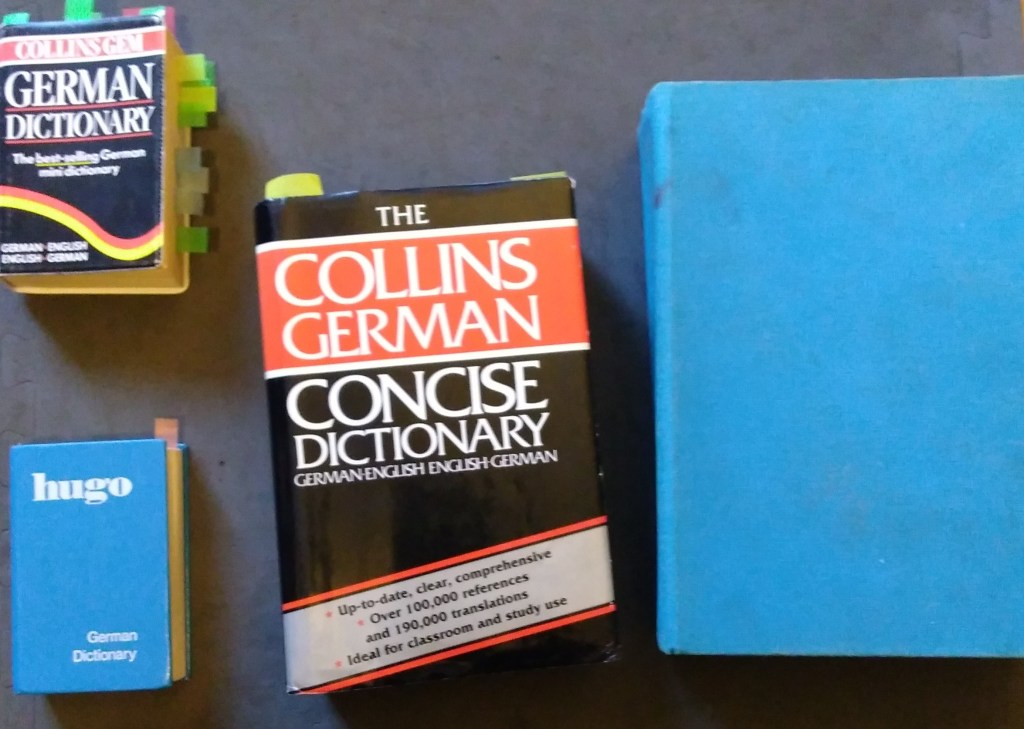
Plural? Yes, reader, I had acquired four German-English dictionaries. These are all bilingual dictionaries, translating from each language to the other. I picked them all up from op shops, second hand bookshops, and antiques stalls — all places that now might as well be on Mars. Here they are:
Meine Wörtebuch
From bottom left, and going clockwise, they are:
Hugo Pocket Dictionary Deutsch (Deutsch-Englisch, Englisch-Deutsch):
Collins Gem German Dictionary (German-English, English-German):
Collins Concise German-English, English-German dictionary; and
Langenscheidts Handwörterbüch Englisch. Teil 1: English-Deutsch; Teil 2, Deutsch-Englisch.
The Hugo was my first German dictionary. It is quite an eccentric little thing: I suspect Carolin thought it slightly weird (although she was too polite to say so). But it has its charms. Its 622 pages are very readable, each being laid out in a single column. Published in 1969, I suspect it to be letterpress printed: the type is mostly very crisp. Its dinky size makes it extremely portable. This is the one I took on our trip. To this end I annotated the inside front cover with travel-helpful words and phrases:
Es tut mir leid (a cover-all apology. “Entschuldigung” came in handy as well; Germans tend to be very punctilious);
Polizist/Polizistin (you never know when you will need a policeman, or woman);
Krankenhaus (hospital)
Apotheke (pharmacist)
Kaufhaus (department store — for when you’ve recovered); and
Bäkerei (German bread comes in many varieties, all extremely moreish).
At 627 pages, the Collins Gem is quite chunky for a pocket dictionary, although it remains very portable. This is a serious bit of a kit for a travel dictionary. The text is arranged in two columns, packing in many more words than the Hugo. Although the Gem is only 5 pages longer than the Hugo, it is a lot wider through the spine. The pages use a heavier grade of paper, which should be more durable. They are rather yellowed, though, suggesting a higher acid content.
The Gem has several useful features. Where a noun forms its plural irregularly, as many do, this is given in the definition — something lacking in the Hugo. It also marks some words as Schlüssellworte (key words). These supposedly are words which occur most frequently, or morph into multiple parts of speech). Hoping to get an inside track on some good vocabulary, I wrote these all on cards. This wasn’t all that useful, however, yielding mostly conjunctions and prepositions, with a handful of irregular verbs. There are lists of irregular verbs in both languages at the back; not the full conjugation, but enough to get by.
As a desk dictionary, the Collins Concise is really an advance on the Gem, being (obvs) quite a bit bigger. Not having a desk, though, the Concise is just a bit big for me. I only have a little lap-desk, previously the back of a picture frame, which I covered in some rubber floor tiles from Bunnings. This has to hold one or two boxes of index cards, the Android tablet, and occasionally a clipboard, as well as the dictionary. So I tend to only reach for the Concise when its smaller brother is found wanting.
The same applies to the Langenscheidt. At nearly 1500 pages, this is the Big Bertha of the four. Its text is laid out in three columns, which looks just a tad crowded. The type is very clear, though, and stands out against very white paper: all highly legible. There are some great tables in the back — would you believe four versions of the phonetic alphabet? Go on, you want to know what they are:
German;
British English;
American English;
International; and
Zivil-Luftfahrt (civil aviation).
Oscar Kilo! Being taken by surprise by a dictionary is maybe a bit sad. I’ll ‘fess up to it nonetheless. The Lango is obviously a more-is-more kind of tool. Like the Collinses, it is part of a large family of dictionaries, generally regarded as authoritative. As this rather stuffy phrase might suggest, I hardly ever use it. Es tut mir leid.
The internet has a huge range of online tools as well: dict.cc and Reverso are two I like. The latter is particularly good for looking up a phrase in context, and verb conjugations. But the Luddite in me thinks: what will happen when the internet is down? When my battery needs charging? What about if I cancel my subscription? Print needs no backup. Besides, I will always enjoy a good print dictionary, whether large, small, logical, or a touch eccentric.
Note to family members — this post doesn’t contain any information that wasn’t in my last email message.
We saw Dr P on Monday, to get the unwelcome news that the PSA was up at the last test. However, the current level is 0.3 — still obviously less than 1. When we found this out, we were somewhat daunted. Our feeling was “a rise is a rise”. The consult didn’t allow us time to process the information or ask what it meant. However, on the advice of Dr P’s PA, I sent him an email with some questions. He rang me back the same day and I learned a lot more about it. The new information:
the increase I had had was not a rise in clinical terms.
He would be worried about an increase of a much bigger trajectory, e.g. if it was
measured in whole numbers (integers), and doubling in 4 weeks. So, for example, if I had a PSA of 5.0 and it went up to 10.0.
Increases in fractions of 1.0 aren’t really accurate anyway. (This information is given in a disclaimer on printout from the path company — a copy of which Phillip gave me on the day.) So, while one may worry about going from 0.09 to 0.3 — an increase of 0.21, which is more than double the first score — it’s a mistake to read too much into that increase. At that quantum it’s not really meaningful.
He doesn’t look at the number itself, but at the velocity of the increase. (This goes back to #2 above.) A steep increase is most undesirable. But if it just grumbles away, as he put it, and increases gradually, that’s not alarming. Scores can move around, particularly under 1.0.
One of the things he teaches his students is not just to look at the PSA, but look at the whole person. Do they feel (and look) well and healthy? On that basis, I am doing very well.
One of the questions I had sent him was whether I would need to move to another treatment (e.g. another round of chemo). He doesn’t think that will be necessary for some time (see below). The longer we can delay my moving to a second-line treatment, the longer I’ll live!
These are the answers he gave me to the questions I had sent him:
Does he believe the cancer is progressing? No.
Is he worried at the last increase? No.
Is he expecting that I may need to move to a different treatment? Possibly, around the end of this year.
He reminded me the treatment I am having presently (androgen deprivation) is Plan A. It has an expected maximum life of about 24 months. (I started it around Christmas, 2018. I can’t recall exactly, as it started as adjunct treatment with the chemo. The latter definitely finished on Boxing Day, 2018 — that I do remember!) Beyond Plan A, however, he has Plans B, C, D and E.
So the whole exercise was quite reassuring. He hadn’t realised we were worried — to be fair, we were wearing masks, which may have made it more difficult to read our expressions. Anyway, I will be talking to him in about 5 weeks, after the next blood test.
There is a lot of ambiguity around PSA. As I commented before, people look for certainty, and want a simple test to see whether they are doing OK or not. There is a temptation to simplify: low PSA is good, high PSA is bad. As you can see above, it is a lot more nuanced than that. Dr P thinks PSA is a really useful way to see whether someone who has been pronounced cancer-free has suddenly relapsed. It is a less useful measure for someone like me in whom the disease is continuing.
However, I think medicos are partly responsible for this fetishising of the score. For the first half dozen or so consults this year, Phillip was very enthusiastic about my having PSA that was undetectable. He seemed different in the last consult, and I read a fair amount into him being much less effusive than usual. I can see I drew the wrong inferences, but then, I’m not an oncologist.
I believe situations like this arise because experts find it really difficult to remember what life was like before they became experts. Their knowledge gives them an incredibly rich context in which to interpret things. Can they meaningfully ask themselves the question “How would I interpret this if I didn’t know what I know?”. It’s an almost impossible task. Also, people join the dots in an attempt to find a “take-out” message.
My take-out from this? If in doubt, ask questions. There’s no statute of limitations — you can ask questions that occur to you after the consult. (My beloved prodded me to do this, and it was the right thing to do.)
First the news — we saw Dr P this morning, and the PSA remains undetectable. (This has been the score the last few times (with minor variations in 100ths of a per cent). Today’s consult was followed by a Zolodex appointment; the latter was scheduled half an hour afterwards. Dr P was running a tad behind, so after the consult I legged it off to the oncology unit at Epworth Box Hill for the implant. That was delivered uneventfully. (I had had a little bleeding from the previous one, which was unusual. There were no problems today, though. The implant is only about the size of a grain of rice, so it is not a big thing to put in.)
After that we had a coffee — takeaway of course — drunk back in the car. Then we headed off to Mitcham, where my beloved wanted to check the size of a pair of shoes she had bought on Thursday. It was good that she did, as she ended up getting a half size bigger than those she had been sold previously. Finalising the transaction took some doing — there were complications. She had purchased two pairs on Thursday, one of which she took with her, the second to be mailed to us later. Much checking was required to distinguish the pair being returned from the pair being sent! (We will have to return this pair to the store for a refund — whenever they arrive.) We had gotten a discount on the price of the pair she had bought on Thursday, and this was duly applied also to the pair bought this morning. Of course the sales assistant we had today was not the one who had done the transaction last Thursday. Etcetera. Anyway, after trying on several further pairs, the slightly-too-small ones were “swapped out” (as people like to say) for the correctly sized pair. We thankfully headed for home after our voyage around the ‘burbs of outer eastern Melbourne. When large areas of the globe were still undiscovered, early cartographers used to write in the blank spaces — here there be dragons!
Over the weekend I caught up with an old friend, with whom I had shared another takeaway coffee and a wander around the local park. He is working at a university library. All Australian unis depend on foreign students to remain solvent; with COVID19, a smaller number of these folk is expected to enrol in 2021. I think many people in the university sector are waiting to see what their jobs will look like when this happens. My friend is no exception. We swapped health updates as well while working our way around Wattle Park.
A lot of people seem to be in this very provisional space at present. Whether we go up a ladder or down a snake seems to be one set of numbers away. The best to be hoped for is to keep plodding along, and staying off the radar. Is it a life stage thing? Was life always like this, or has it become more so recently?
I wore a pink shirt this morning to give myself a bit of a lift, and, I hoped, to cast a healthy glow. I am developing a shirt colour theory of history. Garibaldi’s volunteers wore red shirts (the “Camicie Rosse“). So did the illegally-employed minions working for Victorian Labor Government MPs. These minions were paid out of public funds despite doing electorate work — quite naughty of their employers. (See the ABC Newsstory for those who, like me, had forgotten about this rather sordid tale.) The fascists wore black shirts, Hitler’s Storm Troopers wore brown ones. Conservative pollies — male ones, at least — seem to favour white shirts. Incidentally — hold the presses — I realise I have hardly worn my white shirts since leaving the paid workforce. So colour does stand for something. But what?
As part of my exercise physiologist’s surveillance, I get a three-monthly checkup with her. This is just to see how things are going, how I’m travelling with the exercise classes, and run some basic tests. Because this was a Zoom appointment, the usual testing of things like blood pressure and weight had to be outsourced. (I managed to measure my waist circumference; that was nothing to write home about, so I’ll suppress that for now!) Accordingly I went to a local pharmacy to have a BP check.
As part of my exercise physiologist’s surveillance, I get a three-monthly checkup with her. This is just to see how things are going, how I’m travelling with the exercise classes, and run some basic tests. Because this was a Zoom appointment, the usual testing of things like blood pressure and weight had to be outsourced. (I managed to measure my waist circumference; that was nothing to write home about, so I’ll suppress that for now!) Accordingly I went to a local pharmacy to have a BP check.
The value of this was born out when, surprisingly, the numbers came in a bit on the high side: 145/102. I say “surprisingly” because to date, my BP has been on the low side of normal. When I relayed this score to Lauren, the EP, she suggested I have a retest somewhere that used an arm cuff machine. (The pharmacy used a wrist cuff, which apparently aren’t as accurate.) If the retest was still around the same numbers, I should go see my GP.
I decided to cut to the chase, and saw the good doctor last Thursday. (He hadn’t tested my BP for a while, having assumed that these things were being done as part of my oncologist’s checks. However, the latter hadn’t been doing it either! So it had fallen through the cracks a bit. To be fair, however, it hadn’t been problematic before.) The GP’s test came back with a similar number, so further investigation was required. He ordered several blood tests were to see if any minerals and so on are deficient. He also wanted me to get a portable testing machine for 24 hours. (These are available through Dorevitch Pathology, and probably elsewhere.)
I went to get this fitted this morning. The main unit is pretty small, about the size of an old-fashioned digital camera. This is worn around the waist, and is connected to an arm cuff by a rubber cord. The actual measuring is pretty strong. I’ve never been squeezed by a python, but I imagine it feels a bit like this. (The measurement only lasts 10 seconds or so.)
I am to press a button on the main unit when I go to bed, and again when I get up. Until the bedtime button press, it will measure my BP every half hour. When you tell it you are in bed, it only measures you every hour. (I imagine this will wake me up!) After I get up and do the morning button press, it will revert to a test every half hour. I am to go in tomorrow morning to hand it back. At the end of this week or early next, I will see my GP and get the results of all this measuring. TBC!
Meantime I have been having fun with my German lessons. I realised I love the pedantry of it all, and the fact that there is a right and wrong answer. When I was learning a few years ago, I kept all my books and index cards; blue cards for verbs, yellow for everything else. When I restarted a few weeks ago, I wrote out some more of these.
My system is: when I look something up in the dictionary, I put in a little coloured marker. I go through the dictionary periodically and write up an index card for each word I have marked. I use blue cards for verbs and yellow (or white) cards for everything else. Irregular verbs are marked with an orange dot at the top right. Some cards are general, like the alphabet, numbers 1-20, and so on. But mostly each word gets its own card. The German goes on top with the translation below; this is reversed on the other side.
My teacher Jörg and I also had an enjoyable exchange about index cards. He uses them too, and has four boxes, as follows:
current cards;
words he doesn’t remember at the first test;
words that he does remember;
words that he has learned.
(I guess that, when a word goes into box #4, it would get a final test, which would pick up anything that had dropped out of memory.) I thought this was a great system, and bought another card box and some more packets of cards at the newsagent. I have one card in my box #4: kugelschreiber (pen). As I have one of those classy multicoloured pens, I made up a sentence to describe my pen:
Mein kugelschreiber hat vier Farben: schwartz, blau, grün, und rot.
The recent controversy over vandalism of statues has some interesting points.
It seems as though many people only notice public commemorative statues when these are vandalised or involved in some controversy. The vandalism, and, in some cases, more extreme actions like removal, of statues is obviously linked with the Black Lives Matter protests in the US and UK. The compass needle of public opinion, which started out pointing to current actions by police against African Americans in the US, has swung around to point at instances of racism in general, and to the representation of history that public statues are part of. Some have advocated either removing statues of historical figures like Cook, or adding plaques to the statues which reflect more recent views of these figures.
Brief articles like this obviously can’t do justice to a complicated process which is still playing out. The issues involved are quite politicised. The protesters are unhappy about Cook being described, on one of his statues, as having “discovered” Australia. They correctly point out that it had already been discovered by the Aborigines, who were in occupation long before 1770. (Australia was in no way a terra nullius!) From this viewpoint, the European presence in Australia was an armed invasion. In parts of Australia, in particular country Victoria, European occupation amounted to a war of occupation.
Conservatives in particular are uncomfortable about this perspective on Australian history. Scott Morrison first denied that slavery had been practiced in Australia. His statement today kind-of retracted that, and said instead “I don’t think it’s helpful to go into an endless history wars discussion about this. It’s all recorded. I acknowledge all of that, OK?” (The Age, 20 June 2020).
(Actually, the “history wars” to which he alludes is the controversy about the precise number of Aborigines killed by white settlers. There is a helpful Wikipedia article covering the main threads of this debate — although this might get a few further edits by the time you look at it! As a conservative, Morrison would be well aware of this controversy. For him to imply that the historical record is settled is therefore disingenuous.)
So how do statues get drawn into this? The victors get to write history, and public statues are part of that narrative. The State Library of Victoria has a fair collection of statues, mostly along on its Swanston Street frontage. The subjects:
a pair of metal lions;
statues of Queen Victoria, Prince Albert, the Prince of Wales (Edward VII) and the Princess of Wales (Alexandra of Denmark);
Sir Redmond Barry;
St George and the Dragon;
Joan of Arc;
Lieutenant-Governor La Trobe
two sculptures from the Dromkeen Scholastic Collection of Children’s Book Art.
This list omits a statue of the two soldiers, ‘Wipers’ and ‘The Driver’, which was installed in 1937, but relocated to the Shrine of Remembrance in 1998. There is also a couple of non-representational pieces on Swanston Street: a street sculpture, ‘Architectural fragment’, and the James Joyce Seat of Learning, installed in 1993 and 2004 respectively. My point? There are no statues of Aborigines in this list.
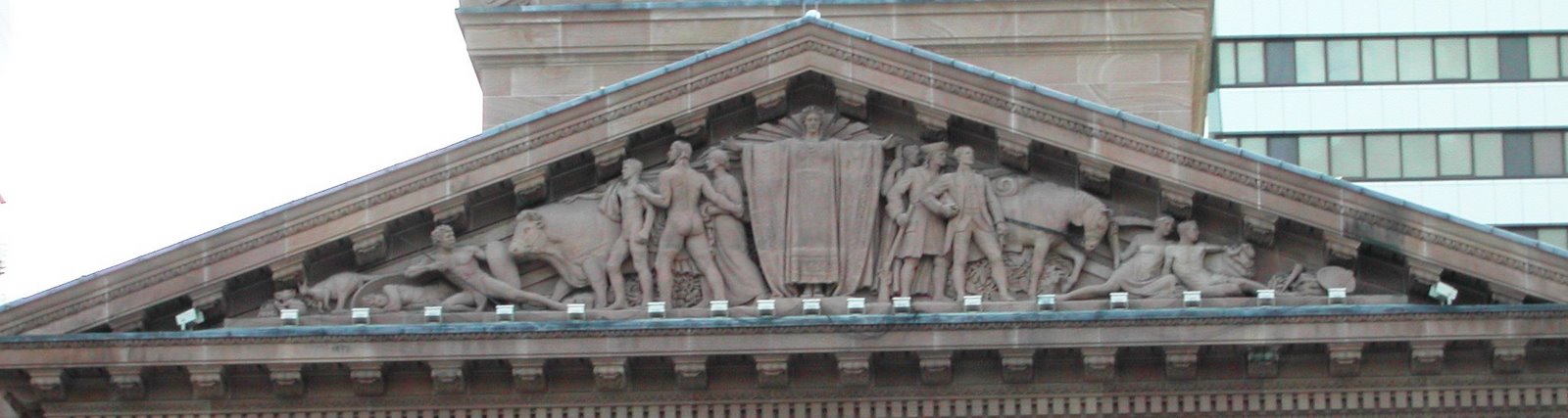
Public representations of Aborigines have, in the past, included pieces like the pediment of the Brisbane Town Hall. There is a good picture of this sandstone relief sculpture in the I love Brisbane blog. Aborigines are featured in this work:
The components are symbolic of the settlement of the State by the early pioneers … The figures to the left hand side represent the native life (man and beast) dying out before the approach of the white man. (I love Brisbane, accessed 20 June 2020)
Below is an image, from the same source. (The Aborigines are in between the kangaroo and the cow.)
The placement of the Aboriginal figures on the left or “sinister” side of the piece is surely not accidental. “Smoothing the pillow of the dying race” was actually still seen as a humane and enlightened thing to do. Works like this illustrate that prejudiced and cliched attitudes were widespread — enough to represent them in on a major civic building.
Modern statuary has sought to balance this portrayal of Aborigines by acknowledging historical events, and featuring works designed by Aboriginal artists. In 2016, the City of Melbourne installed a memorial to Tunnerminnerwait and Maulboyheenner , two Aboriginal men who participated in a guerilla war against white settlers. They were hanged in January 1842 at what is now the corner of Franklin and Bowen Streets, the site of their memorial. The latter sits lightly at that busy spot. Nearby on the RMIT city campus is a cast iron statue, Wurrungii Biik, representing Burundjil the Great Creator Spirit.
To have statues like these in our cities shows that images of our past have evolved along with our attitudes. Things that could not be acknowledged, whether from shame, guilt, or ignorance, can now be portrayed and talked about. Statues matter because they are everyone’s birthright. They become characters in the dialogue that is our history.
 Guy's prostate blog