Who needs Commonwealth Games?

We saw Dr P yesterday morning, and the news was mixed. The PSA at the last test was 47 — a rather unenviable record — even a PB. There are always “howevers”, though, and here they are:

  • Dr P said he would need three consecutive rises in the PSA to consider changing my treatment (i.e. to chemotherapy).
  • In any case, he can’t move on this while I am having the radiation treatments at Peter Mac. Fortunately
    • He thinks there is no urgency to go with some more chemo.
    • I should be finished at Peter Mac by mid-September. This fits in with my next appointment with Dr P. So there should be no WICOS problem. (This is a useful acronym for “Who’s In Charge of The Ship”.)
    • By mid-September, I will also have had my regular three-monthly CT head and neck and bone scan. From this, Dr P will have hard evidence on whether to embark on another round of chemo.
  • Dr P said “On paper, you look terrible, but in person, you look fantastic”. (You will all remember that he places more store in the latter than the former.)

I certainly feel fine, and haven’t noticed too many side effects from the radiation treatment. What side effects I have noticed are a bit more fatigue, and a slight loss of focus in my left eye (the one being irradiated). I have reported the latter to my radiation oncologist; the effect should be temporary. I still have enough focus in the left eye to drive; I guess also the right eye takes over somewhat to compensate. (I have to stress that the radiation therapists take great care to shield those areas of the eye not being irradiated. Doing this takes most of the appointment — the actual radiation only takes a few minutes.)

Today I start the double appointments, i.e. the left eye first, then the head and neck area. Because they are done on different machines, they have to be separate appointments. But the Peter Mac folk have brought them as close together as possible. Getting in and out to these appointments should be easier from next week, when patient transport via the ambulance service will start. (I blogged about this in One Week In .) I found, after about an hour of fooling around on the Ambulance Victoria site, your doctor has to get the ball rolling on this. Fortunately, before I embarked on the DIY approach, I had first left a phone message with the Peter Mac patient transport folk. They rang me back, and it was all set up.

Meanwhile I have two more days remaining of being driven in by my beloved. I am not only deeply appreciative of her doing this, but I also get to chat with her at a time when she would normally be working, which is really lovely. She has also stepped up to the plate, as it were, in the kitchen. Truly a heroine!

Season 3 of Only Murders In The Building is providing a good distraction from all this. Disney+ is doling these out somewhat; as of 8 August, only two episodes had dropped, which we watched one after the other. Apparently this belongs to the genre, probably invented by Agatha Christie, known as “Cosy Murder”. For those who would like to check this show out, APPARENTLY OnePass offers a free 14 day trial of Disney+. (The all caps denote that I haven’t tried this offer myself. No care or responsibility taken. Unfortunately I’m not getting paid anything for this promotion.) I think Seasons 1 & 2 are still available. As Peter Cundall used to say — OK, that’s your bleeding lot!

Merkel vol. 2

You will remember, after the sentinel lymph node biopsy, I was to be told the results of this operation. I did hear about this last week, and the CT scan did show some isolated and small Merkel cells in one of the lymph nodes. Consequently my radiation oncologist at Peter Mac, Dr M, has started me on a course of radiation directed at the lymph nodes in the head and neck area. This course will overlap the one which has already started for the upper left eyelid, and will be of about the same duration. Both courses of radiation are now to be administered five days a week, instead of four as previously. The object of this is to shorten the duration of the overall treatment. I now expect to be finished with the lymph node treatment about mid-September. I am not sure exactly when the lymph node treatment will begin — possibly next week. Dr M, who is overseeing both treatments, will try to keep the two appointments as close as possible each day, so we are not hanging around Peter Mac for too long.

As preparation for the lymph node procedure, I had a mask made to cover the entire head and shoulder area. The mask protects areas other than those on which the treatment is focused. It is made of a kind of white plastic mesh. It was first soaked in warm water, then applied over my head. It shrank a bit to fit the contours of my face — a weird sensation, about which I had been warned. While this was in place, I then had a CT scan. Including waiting for one of the assistants to turn up, all this took about an hour. It was followed by the usual radiation session for the upper left eyelid.

The prostate cancer treatment of course is continuing. I have made a mental note to tell Dr M to keep Dr P in the loop about the lymph node business. (Last time I saw Dr P, he knew I had been referred to Peter Mac.) I will be seeing him next Wednesday for my regular monthly consult. In preparation for this, I had a blood test on Monday. Afterwards I repaired to an op shop, handily just across the road from the pathology place, where I have previously found some decent CDs and vinyl. This time I scored a nice cardigan, a sort of ginger or peanut butter colour, and a terrific piece of knitting — very tight, no missing buttons. (From a few hanging strands inside, presumably from where the wool ball had run out, we surmised it had been hand knitted.) Op shops seldom have jumpers that are worth wearing, being either pilly, food stained down the front, or both, so this was a good find.

One week in

So far I have had four radiation sessions for the Merkel carcinoma discovered on the upper left eyelid. This feels like enough sessions from which to report on how things have gone so far.

First, getting in there is a lot easier than it could otherwise have been. As previously reported, my beloved is steadfastly driving me in to the appointments. These are all scheduled, from Monday-Tuesday and Thursday-Friday, at or around 2.00 pm. (No sessions on Wednesdays.) We allow an hour for the trip, so leave after an early lunch.

(There was a potential alternative means of getting in and out mentioned by the Peter Mac people, i.e. free patient transport both ways. Ripper, Rita! Unfortunately, as with so much else, when investigated, this proved to have a few hairs on it. This patient transport service is provided by Ambulance Victoria; to use it, one has to be a paid-up member of theirs. We had vaguely thought that we were covered for ambulance transport through our health insurance fund. We are, but only for emergency transport. We have since joined AV, of course, the cost of which was quite modest. There is, however, a 14 day waiting period on non-emergency patient transport. So much for being a free rider — no pun intended. The hospital did warn me that return trips could be quite delayed, for reasons of which they weren’t quite sure. Nevertheless, when I qualify I will definitely investigate it. In the meantime, though, it is not totes terrible for my beloved. She takes in her laptop and connects via the Peter Mac wifi. Being on sick leave from her employer, she is excused from having to drive in there twice a week. She is still doing a mighty job!)

Second, the sessions themselves are not a big deal. Someone comes out to fetch me and waves their way through secure doors to the radiation department. Within these hallowed halls another radiographer, or whatever they are, is waiting alongside the machine that does the business. I recite my name, rank and serial number each time — they are keen to avoid zapping the wrong patient — and recline on a narrow sort of bed with side rails. (They raise it for this purpose, following the reverse procedure afterwards.) They put a couple of numbing eye drops in the left eye, and fit a lead mask (this was fitted around the contours of my dial in the measuring session the week before last). After the drops have had their effect, the radiation folk gently slide in the metal shield that sits on top of my cornea. This is a bit like a large contact lens, fitting underneath the upper eyelid, which holds it in place. The drops numb my eye to the point where I can feel the shield going in and sitting there, but without any discomfort. Obviously all this faffing around is because of the location of the carcinoma on my upper eyelid, and the corresponding need to protect the surrounding areas. So whatever they do is fine by me!

When they are happy, one of the radiographers goes through a brief checklist with the other covering what they have done and to whom. They tell me not to move, and retreat elsewhere before starting the actual radiation. This only lasts a few minutes, but I am still rather glad to hear their footsteps approaching, followed by their congratulations for having done such a good job of lying on the bed. They put an eye patch over the left eye, and I make my way back out to the waiting area. (The eye patch is in case the eye gets some grit in it. Being still numbed from the drops, the eye wouldn’t give the usual signals that would prompt one to rinse out the grit. Damage to the eye might therefore result. This is typical of the thoroughness and foresight of the Peter Mac radiation staff.)

The effect of the sessions is mainly in feeling a bit tired when we get home. Apparently the side effects are more apparent the more sessions one has had. These side effects are felt mainly on the eyelid and eyebrow; the former becomes red and irritated, and the latter tends permanently to disappear. (My beloved is being very assiduous in daubing a cold cream-like ointment on the eyelid, and “encouraging” me to drink five glasses of water a day. These are preventive measures the nurse we saw earlier recommended.) Last week I felt well enough to go to an exercise session on Wednesday — something I intend to keep up.

Make mine a Merkel

Avid readers (such as all you lot) will remember I was booked for a sentinel lymph node biopsy in at the Peter Mac yesterday.

This went uneventfully, if rather lengthily. We were booked in for a 7 am arrival at Peter Mac, meaning a 6.15 departure from Burwood. (A general anaesthetic being involved, I had had to fast from midnight, which simplified the morning arrangements.) There was a surprising amount of traffic on the freeway at that time, but after winding our way down to a subterranean level of the PM multilevel car park, we were there pretty much on time.

PM is a very modern hospital. On arrival, one stands in front of a temperature check machine. If one satisfies its requirements, it dispenses a sticky label to denote one’s patient or visitor status. The lifts are fun too. On selecting the required floor from a touchpad, an automated voice intones “Car N” (or whatever it is). Once inside, no need to press buttons — the lift knows where it’s going. (Dad would have loved it!)

Mine was a two part procedure. In the first, I went to the day surgery department, was assigned a cubicle, put on a standard hospital gown, and packed my possessions into a few plastic bags (which remained in that cubicle). I was then guided to the nuclear medicine department for three injections with a radioactive substance. The purpose of these was to highlight any lymph nodes around the face and neck area to which the Merkel carcinoma had spread. The injections were administered in the skin between the eye and eyebrow, and were rather painful, of which I was forewarned. One of the staff kindly gave me her hand to squeeze at this point. I got a lot of congratulations on my bravery! (I bet they tell all the boys that.)

Then followed a couple of periods of lying on a gurney under some high tech machinery to see what lymph nodes were lighting up. Two goes at this were required because the radioactive stuff hadn’t worked its way around. (Apparently there is quite some individual variation as to how long this takes.) After pacing around the huge machine a few times, doing some stretching, and massaging the area where I had had the injections, they laid me down to try again. “I think we’ve got something!” someone said. An orderly helped me get up (about an hour in total on the gurney, I was pretty stiff) and onto a wheelchair, and he and I headed back to the day surgery area.

Here, when my number came up, I was transferred to a kind of mobile bed, thence to the anaesthetic room. Here I was asked for about the fourth time that morning my name, address, and date of birth. Satisfying these requirements, a team of two anaesthetists (!) and an anaesthetic nurse swarmed around me and knocked me out. I woke up minus one or more lymph nodes back in the cubicle. My beloved had been working away productively on her laptop all the while in the hospital’s Wellness Centre. I was offered a sandwich and a coffee, both of which I accepted gratefully. Then I whizzed home with my beloved in the RAV, arriving about nine hours after we had left that morning.

As anyone who has ever had an operation will recognise, this is a rather bare account. There were a few quite lengthy delays between the main events, mainly due to waiting around until various people were available, until the radioactive injections had done what they were supposed to do, and until my number came up on the surgical list. Everyone was very kind and kept us both informed as to what was going on. This morning the area in my neck where the surgeon had made the incision was quite swollen and a bit sore. I didn’t need any pain relief for this, though, and generally didn’t feel too bad. I will be having a further consult with the surgeon next week to discuss the biopsy results. At some point (I’m not sure exactly when) the radiation treatment will begin, to last about 5 weeks. I guess the particulars of this treatment will be guided by what the biopsy tells them. TBC!

A new companion

There is a bit to catch people up on, so I will just put it all in point form. (I have condensed a lot of medical appointments and put things out of strict chronological order. Trust me on this.)

First, the Merkel carcinoma.

  • About a fortnight ago I had an operation to remove a growth on my upper left eyelid. This was picked up in my annual eye check at OPSM, who referred me to a local opthalmologist. He (Dr L) removed the growth and sent it to be biopsied as normal.
  • This turned out to be a somewhat unusual cancer called a Merkel carcinoma. Merkel is a quite aggressive cancer, which can spread widely under the skin. Like other aggressive cancers, it can infect the lymph nodes. On the positive side, it responds well to radiation treatment. Dr L referred me to the Peter MacCallum Cancer Centre for further treatment.
  • My beloved and I spent a couple of days there last week. In these appointments I had a PET scan, then met a radiation oncologist and a couple of plastic surgeons. (The PET scan showed that the Merkel had not spread to the lymph nodes in other parts of my body.)
  • The radiation oncologist was there to talk me through what radiation treatment would look like. In short:
    • I will be having 30 sessions of radiation over six weeks.
    • Before this starts, I will need to be “marked up” by having a lead shield custom made for the contours of my old dial. This will ensure that only the appropriate areas are irradiated.
    • To the same end, a little metal disc like a contact lens will be placed over the cornea of the left eye, underneath the upper lid.
    • Fortunately, each session of RT will only take 15 minutes or so.
    • The markup session was yesterday. The team working on me took great pains to shape the lead shield to fit me closely. I had some numbing eye drops applied before they put the metal shield in place over the cornea. The discomfort of this was not nearly as bad as I had thought.
    • Apparently I can expect some redness and soreness of the upper lid as the treatment progresses. I will also lose the left eyebrow. (This is OK; the one I can raise is the right one!)
  • The plastic surgeons were there to talk me through a procedure called a sentinel lymph node biopsy, for which I am booked in on Monday.
    • This is mostly a diagnostic procedure which will reveal whether the Merkel has spread to any of the lymph nodes in the head or neck. It does so by injecting a couple of radioactive dyes at the area where the original surgery was performed.
    • The procedure does not do anything to “cure” the cancer: it merely shows to which lymph nodes it might have spread. This is an important thing, however, because the radiation folk will need this information to proceed to treat any affected lymph nodes. (As I think of it: they can’t shoot at what they can’t see!)
    • SLNB also has the benefit of allowing any cancerous areas to be detected while they are still small. Removal of small cancers is easier than if they have been allowed to grow (and spread).
    • I asked the radiation oncologist why I was having the markup session yesterday and the SLNB on Monday. Shouldn’t they be in the other way around? She said that normally this would be the case. In my case, however, they were regarding the treatment of the lesion on my upper left eyelid, and treatment of any affected lymph nodes, as separate procedures. The markup was only applying to the former.
  • The Peter Mac’s location in the Melbourne CBD makes getting to all these appointments a bit of a bore. (It does have a Box Hill campus, but they can’t provide the treatment I will require.) Driving oneself is not recommended because of the effect on the vision of the numbing eye drops which the radiation sessions require. Fortunately, however, my beloved is stalwartly driving me to them all. She will pack her laptop and work away on the free Peter Mac wifi.
  • Apart from its location, I am greatly fortunate in having been referred to the Peter Mac, unusually (and fortunately) a public institution. Consequently all this treatment and surgery is not going to cost us a cent. The staff there are quite wonderful: it has pretty good coffee too! Out taxes at work.

OK, onto the prostate cancer.

  • The PSA has gone up to 33, but only by one. I am counting this as a win! (A bit like the England cricket team feeling as if they won the first Ashes test.)
  • Dr P had been told all about the Merkel. He is happy to hold off on any change to treatment for me (i.e. chemo) until after the radiation. (Not that I seem to need that — see below). This avoids the WICOS problem that I read about in one of Atul Gawande’s books. This initialism stands for “Who’s in charge of the ship?”: a question that can arise when a patient is being treated by several specialists.
  • Incidentally, Dr P said he has one of the biggest Merkel practices in Melbourne. So when I have worked through the treatment at Peter Mac, I could come to him for that as well (if I wanted to). However, he is going away for five weeks, and we need to get onto the Merkel PDQ. So we decided to stick with Peter Mac.
  • Later that day I had a Zolodex implant, which went well.
  • Goddam it, I’ve forgotten how to mark the following up as a paragraph! This new WordPress editor gives me the Jimmies. You’ll just have to work it out.
  • In the morning before I saw Dr P, I saw a gastroenterologist to whom he had referred me, Dr B.
  • In a phone consult I had explained I was suffering from shortness of breath and dizziness on getting up. He asked me to measure my blood pressure sitting down, then standing up.
  • Before the in-person consult, I had been increasing my consumption of iron rich foods as much as possible: two eggs for breakfast, meat sandwich for lunch, and so on. I had also doubled my iron supplement to two Ferrograd-C tablets per day — although only after the blood test which he had ordered for me. (The extra dietary iron may not fix the deficiency, but I figured it couldn’t hurt.)
  • I gave him a couple of sitting-to-standing readings in our in-person consult. These revealed quite a drop between the two states — hence the dizziness. (He wasn’t interested in the BP after I had been standing for ten minutes or so.) Normally the body compensates for the change in states; however,for some reason this wasn’t happening in my case.
  • In the consult Dr B said my iron level was “OK at present”. (Maybe the eggs and meat had been doing something after all!) He thought the Ferrograd-C contained too much iron for the body to assimilate, and suggested I drop the dosage to one every other day.
  • Fortunately, he didn’t suggest a colonoscopy! (I had had three “scopes” about five years ago, when the low iron was first picked up.) He did suggest that I have a heart ultrasound in case there had been any partial heart failure. After all the dust clears from the Merkel, I will investigate this.
  • I am generally feeling better and getting less puffed after walking up an incline. So I am planning to continue with the iron-rich diet.
  • That’s your blooming lot! Comments not questions, please.

You should have seen the other bloke

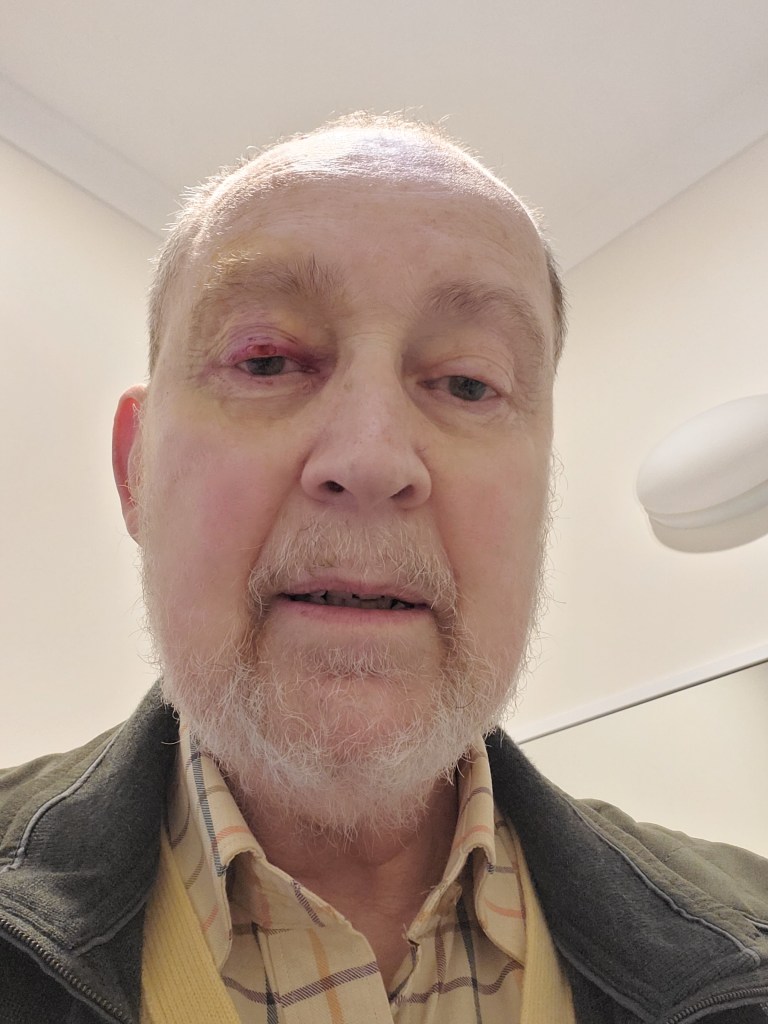
This morning I had a brief operation to remove a small growth on my upper left eyelid. (For some reason, the picture above is reversed; the shiner is definitely above my left eye.) The growth had been detected during my annual eye test. I hadn’t really noticed this; it was blocked by the upper frame of my glasses, and I couldn’t see it when I wasn’t wearing my specs! Anyway, the optometrist recommended that the growth be removed by an opthalmologist.

I saw the specialist to whom the optometrist had referred me, Dr L, last week. He said it probably wasn’t cancerous, but that pathology tests would confirm this. If it turned out to be, he would need to take out a bit more. (The plus side is, in that instance, my health fund would pay a rebate for the first operation!)

My original appointment at the eye clinic was for 10.45 this morning, but they rang about 9.15 and asked if I could come in earlier (they had had a cancellation). This suited me and my beloved, who was to drop me off there and pick me up afterwards. (This was necessary because I was to have a local anaesthetic and eye drops.) Anyway, we beetled off there about 9.30. After an extensive induction and history-taking (all of which had taken place at the earlier consult), an anaesthetist gave me a local and some other shot to reduce any anxiety I might have, and Dr L speedily removed the growth in the clinic’s theatre.

I had had to fast this morning, so was glad to have a couple of cups of tea afterwards — they didn’t run to real coffee — and a sandwich. The only real holdup came when exiting the practice.

The building is situated on sloping land, with a small concreted area of outside the front door, clearly intended for short-term pickups and dropoffs. There is a narrow driveway running downhill to the right of the building, which leads to the practice car park. Because of the slope of the land, however, patients entering the practice from the car park need to climb quite a steep metal staircase, which has a right angle bend in it. The nurse therefore directed me to tell my beloved to park on the concreted area outside the front door, so I could exit without going down the staircase to the car park. (I had a patch over the left eye at this stage, and was still feeling the effects of the anaesthetic. These things would have affected my depth perception and so on.)

The problem with this sound advice was that there was already a car parked on the concreted area outside the front entrance. My beloved therefore went down the driveway, heading for the car park. She couldn’t even park there, however, because she was blocked by a truck making a delivery! Regardless, the nurse was adamant I couldn’t walk down the staircase, even with assistance. Of course they couldn’t have prevented me if I’d insisted, as I was on the verge of doing. (I just wanted to get out of there at this stage.) Anyway, my beloved drove around the block and parked behind the illegally parked car. I resisted the urge to let down its tyres as I made my exit. (Had I had my wits about me, I would have keyed one of its doors — I was pretty cross that its owner was being so selfish.)

Anyway, all is done now. My beloved reckons I look as if I’ve been in a fight, I’ve resisted giving way to my anti-social urges, and am being waited on like Lord Muck. For a while I even looked like the Whitmont Man!

Movement at the station

We went to see Dr Parente last week. Preceding this appointment on 7 June, I had had the usual blood test, and following that the three monthly CT and head/chest scans. I had been feeling tired and just vaguely unwell, without being able to put my finger on just why. So I wasn’t expecting great news.

There wasn’t much of that forthcoming — the PSA is now 32 (up from 24). However, Dr P was, as usual, quick to provide reasonable and reassuring observations:

  • As ever, he cautioned against being too obsessed with the PSA score to the exclusion of other things.
  • He observed that I was seemed very well, was generally feeling well, and was much healthier-looking than most of the patients I could see in his waiting room.
  • The fact that I was still carrying some COVID kilos was a sign that I didn’t have progressive disease.
  • My alkaline phosphatase (ALP) score had not risen, remaining in the normal range. (ALP is a liver function enzyme; there is a good little article about it at verywellhealth.com.)
  • The doctor who had reviewed the current lot of scans thought that I was experiencing mild progressive bone disease. Based on the points above, Dr P disagreed with this judgement.
  • The fatigue I was experiencing was one of the major side effects of enzalutamide.

I think I just have to get used to the PSA increasing, as it has done the last however many times. As long as I am feeling well, that is OK (although I continue to feel tired — more on this below). Dr P is holding off on another round of chemo for now; it would, as he pointed out, be quite intrusive and destructive of the activities I am now enjoying.

Another reason for the fatigue is that my iron scores are again decreasing, from 61 to 21. I had low iron last in about 2017; I experienced the effects of this as being easily puffed when climbing steps or inclines. I was referred to a gastroenerologist to investigate this, who gave me a colonoscopy, a gastroscopy, and a capsule endoscopy. None of these provided a reason for why my iron should be decreasing. He referred me to have a couple of iron infusions, which did the trick in terms of bumping up my iron, but which I found quite time-consuming. So I requested instead to go on iron tablets, of which I have one each morning (a Ferro-grad C). The blood tests I was having at that time revealed, however, a suddenly elevated PSA level. When prostate cancer was diagnosed, the low iron was pushed into the background.

Six years later, it has re-surfaced; I believe it is behind the fatigue and shortness of breath I am experiencing. My GP got together with Dr P, who referred me to another gastroenterologist, who practises in the same building as Dr P. I am seeing this gentleman, Dr Bloom, on the morning of 5 July. (On this day I am also seeing Dr P, and having my Zolodex implant.) So I will probably be having more iron infusions. The original round of these was delivered in 2017 in the day oncology unit at Epworth Eastern. This is a place I have gotten to know well over the last few years. This was where I had the original iron infusions, a round of chemo, and (following this) my three-monthly Zolodex implants. Anyway, I’m sure the new round of infusions will make me feel less lethargic.

Mixed in with these intestinal matters is also a small matter (I hope) of a little crusty growth that my optometrist noticed on my left upper eyelid. So I have been referred to an ophthalmologist to have that looked at, and probably removed.

We have been a bit in the wars of late. My beloved has had a recurrence of the pain and swelling in her right jaw and cheek respectively. A trip to the dentist and some X-rays revealed an infection, which is being treated with antibiotics (probably a couple of courses). She is soon to see an endodontist to have this investigated and dealt with. Meanwhile the antibiotics have greatly reduced the pain and swelling. Thank goodness for modern medicine!

Not taking sides — updated

*******************************************

I gather there were some issues with people not being able to see the previous version of this post. Apos for that! I had restricted the access condition to subscribers, naively imagining that my readers mostly had a subscription. Some do, but have difficulties opening posts. I have taken this up with WordPress, but not gotten very far. I have definitely changed the setting on this updated post to Access: Everyone. People who get the alert, but can’t see the whole post, could try refreshing their browser.

Anyway, I am putting this update at the head of the post, so people who could read the content previously posted don’t have to scroll through it again. I previously discovered that the channels on the turntable were hooked up incorrectly, in the sense that the right hand channel was actually the left, and vice versa. Then I wondered whether I was having the same problem with my disc player. It wasn’t easy to determine, because I didn’t have a stereo check CD or DVD. However, the player (a Cambridge Audio) has a fairly primitive YouTube browser built in. So I found a stereo check video and played it back. This was basic in the extreme, consisting of someone reciting “Left channel, left channel, left channel”, then “Right channel, right channel, right channel”. (The sound was put through the correct stereo channel alternately, obvs.) Anyway, it showed me that each channel is coming through the correct speaker. Here endeth the update.

*******************************************

Warning — ultra nerdy content ahead.

I had an interesting trawl through my local op shop yesterday, coming back with three DVDs and two LPs. We watched one of the DVDs last night, quite an interesting 2007 “neo-noir psychological thriller”, Disturbia . A good mid-week flick, featuring a breakout role for Shia LaBeouf. (The other discs I haven’t seen yet.) I regard op shop DVDs as a cheap indefinite loan. For convenience I have the region settings of the Blu-ray recorder in my phone, so I don’t end up buying something I can’t play.

The vinyl was pretty interesting. The first one I played was Vangelis’ sound track to Chariots of Fire. (Not going to link this, you’ve all seen it!) Side 1 comprised various tracks from the movie sound track, all played by the monomynous Vangelis, except for the original choral version of “Jerusalem”, by Hubert Parry. (This must also have featured in the sound track — it was so long ago that I saw it, I really don’t remember.) Side B was a kind of fantasia on the main Chariots of Fire theme, played on various keyboard instruments also by Vangelis. This was all quite a blast from the past, and a very well produced LP.

The second one was quite an ear opener. This was a demonstration disc called “Miracle in Sound: the Festival Stereo Sampler” (Festival Records, SFL-2/1). Strangely, this is an Australian label, although the content originates in the US. Side 1 began with a follow-the-bouncing-ball track, intended to show whether your speakers are set up with the correct left to right orientation and phase. A bouncing ping pong ball sounded first out of the left, then the right channel. Following this, the bouncing ball is heard alternately left and right. Finally, the ball appears to be bouncing in both channels simultaneously, to allow one to hear the elusive “middle channel”.

I have had stereos since the 1970s, when vinyl and cassettes were all there was. I used to have about 300 records, most of which I gave to 3MBS-FM. However, the vintage Luxman tube pre-amplifier I bought about seven years ago has a very good phono stage. This has encouraged me to start collecting vinyl again. Well, when I played “Miracle in Sound”, I was glad I was sitting down! My speakers were reversed — for the turntable, at least. What I had thought was the left channel was actually the right, and vice versa. This is totally a rookie error, which I couldn’t believe I had made. Still less, having made it, that I hadn’t noticed it! Que?

Something that made the reversal harder to pick up was that the balance control worked correctly, i.e. when turning the knob to the left, sound was transferred to that channel, and vice versa. My stereo also is hellaciously complicated to set up. This is because it has not only a separate power amplifier and pre-amplifier, but also a powered subwoofer. My valve amplifier guru Dallas drew me a diagram to aid me in which leads have to hook up to what. Physical access is quite complicated also, with little room to get behind everything and check. So the possibility that, at some point, I swapped over some leads is quite a real one.

There is a subtler extenuating factor, if you like, to do to with orchestral layout. Growing up and going to concerts in Australia, one might think that orchestras are always sitting with first fiddles on the conductor’s left hand, followed (reading left to right) by second fiddles, violas, and cellos. Second and third tiers are woodwinds and brasses, with double basses behind the cellos. Percussion at the back. Well, after looking at maybe a hundred Berlin Philharmonic concerts (on their Digital Concert Hall service), I can tell you, their string sections sit quite differently. First fiddles on conductor’s left (same as here), but then violas and cellos next to them, then second fiddles on conductor’s right. Alternatively, the violas can swap with the second fiddles. Double basses can be behind the first fiddles in the second tier, on the conductor’s left, or in the middle. It all depends. All these seating arrangements affect the sound stage; otherwise, I might have realised something was wrong earlier.

Fortunately the pre-amp has a nifty feature — a “Reverse Stereo” switch. This swaps around the channels left to right, without having to touch any wires. Everything suddenly sounded as I imagined it should! Simple. Except that now I have to figure out whether the outputs from my my disc player are reversed left-to-right as well. If so, when I am going from playing a record to a CD or DVD, I have to remember to un-reverse the channel reversal. Hifi paranoia, here we come!

PS Please, no advice to ditch the stereo for something simpler! If I didn’t have this to fiddle with, what would I do?

TV or not TV

I recently stumbled across the title of a book that I read, then lost track of: Bowling alone, by Robert D. Putnam (Simon & Schuster, 2000). The author, professor of Public Policy at Harvard University’s John F. Kennedy School of Government, was exploring the phenomenon of the decline in social capital since the 1950s. By “social capital” Putnam meant the participation of Americans in social institutions by standing for public office, and joining political parties or trade unions, religious groups, parent–teacher associations, veterans’ organisations, volunteers with Boy Scouts and the Red Cross, and service clubs such as Rotary. People are now less prepared to join these groups than was the case in the post-war decades. The level of trust they express in governments and social institutions generally has also declined.

I don’t doubt that this trend was a general one. In my childhood in Darwin, I remember my parents going to card nights, singalongs around the piano, and picnics with friends. OK, Darwin was a pretty small place then. The past is a foreign country, as L P Hartley observed. If you lived in Darwin in the 1960s and had a family, you mostly made your own fun. But when we moved to Sydney, my parents stopped participating in most of these forms of socialising. Of course they knew many fewer people there. Sydney offered substitutes, however, such as the Mensa organisation, which would probably not have been an option in Darwin. Joining this gave my father the opportunity to organise bridge and chess games at our place. There was also TV.

Why have overall levels of sociability and trust receded from their high in the decades immediately following WWII? Putnam attributes these phenomena primarily to the increasing prevalence of television and other electronic forms of entertainment. Other factors included the increasing participation of women in paid employment, and the effects of suburbanization, commuting, and urban sprawl. (I have cribbed these and other details from the Wikipedia article about Bowling Alone.) It all might sound rather dry, but Putnam, as I recall, is a graceful writer. As one might expect, his conclusions are all well buttressed with survey and other data, and his book has a substantial bibliography. It made quite an impression on me when I read it, so I was glad to be reminded of its title.

Independently of this, I had been thinking about television and the tremendous ways in which it has evolved. This was particularly clear to me, given that Darwin in the 1960s did not have TV. (The fun I had to make there included playing records and listening to Tarzan serials on our Kreisler radiogram.) I first saw TV in Brisbane during a family holiday to Queensland in the 1960s. I found it entrancing. As soon as we returned to our accommodation, I would switch the set on, regardless of what was being broadcast. The medium was truly the message.

TV then of course was black and white, and limited to a handful of channels. My beloved grew up in a regional area where there were two channels — the ABC and a commercial. She became an authority on the programming available at any given time of day or night. Before programs were shown, at 8.00 or 9.00 in the morning, the test pattern was broadcast. The evening’s viewing always concluded with the Union Jack rippling in the breeze, to the strains of God Save the Queen. (I’m sure some people would have stood up at home while this was playing. When writing this, I was curious about whether this had actually been a thing. All I could find was a story about how the Mission Barbecue chain in the US plays The Star-Spangled Banner at 12 noon, at which patrons may stand, doubtless with the encouragement of some of their fellows.)

A former housemate of mine referred to a female life partner as “she with whom one watches TV”. During the thousands of hours of TV I have watched with my beloved, we have gone from her flickering old black and white set, to a hulking Philips colour cathode ray TV that I lugged around to three domiciles, to our current Panasonic flat screen. We had the Philips CRTV for about 16 years. it had the boxy 4:3 aspect ratio; when digital channels came in, it required a set-top box to receive them. When we bought our place in Burwood in 2014, I refused to move this heavy old relic one more time, and bought the wide screen Panasonic from a Dick Smith store — back when these places still existed.

Our previous place, in Camberwell, had ushered us into the era of the second TV. The first of these was a tiny set, purchased in about 2013, which had a screen about the size of a microwave oven door. This tiddler went originally to the sunroom of our house in Camberwell, then to the study of our current place in Burwood. It gave up the ghost (no pun intended) just a few weeks ago. I replaced it with a much bigger Blaupunkt set, purchased in a Coles supermarket for $210. (Only a few TV manufacturers make their own screens, so a no-name TV will probably work as well as a recognised brand, and certainly last as long.)

When we bought our first VCR, this ushered in the era of time-shift programming, a.k.a taping off-air. The Green Guide insert in Thursday’s The Age lists the TV programs for the week. It became a ritual to go through the Green Guide and set up the following week’s programs to record. This could be a delicate operation: allowance had to be made for programs which started early and finished late. The commercial stations were the worst for running behind time, particularly when the programs had been preceded by a football match, charity broadcast, or other program likely to run over time. Much unhappiness was expressed when once (once!) I failed to sufficiently “pad” the end time of a recording of Cold Feet. Consequently the precious last few minutes of an episode were missing in action. (Of course this was the exception which proved the rule. On a very few of those occasions, too numerous to mention, when we had been able to watch the entirety of a program, I allowed myself to point this out. This did not prevent some good helpings of hot tongue and cold shoulder from coming my way after the initial offence.)

Other pinch points occurred with taping off-air. The early machines had a limited capacity to record, so when multiple programs earmarked for off-air recording overlapped each other, some bargaining had to be engaged in to pick a winner. The VCR could not record while a program was being played back. Thus when we were playing something back, and the VCR began setting itself up to record a second program, the playback had to be suspended until the recording of the latter had been completed. Our current hard drive recorder allows not only the recording of three programs at once, but also playing one of these back while it is still recording. Better still, it records closed captions. A program broadcast over several episodes, such as a series, can be set up to record in one go, and will stop recording when the series is completed.

Despite all these refinements, our current HDD recorder will probably be our last. I still engage in the weekly ritual of setting up programs to record. Each time yields fewer noteworthy offerings, however, to the point where it has become bit of a waste of time. The streaming services have such a wealth of content that I can’t remember when we watched something on a free-to-air channel. Like everything, this has its advantages as well as drawbacks. On our recent trip to Singapore, we found the TV set in our hotel room had none of the streaming services we watch at home. Fortunately, I had installed the apps for these services on my Samsung tablet. The TV in our room, also fortunately a Samsung, had a feature called screen mirroring. Using that I was able to first tune into Netflix on the tablet, then mirror the tablet screen on the TV — including captions. The broadcast could be paused and continued at will. None of this would have been possible before the advent of wifi, streaming television services, et al . (Perhaps my rigging up this Rube Goldberg arrangement restored a few brownie points, after having cut off Cold Feet, as it were, many years previously.)

Streaming brings a torrent of content to our living room. It can also split us into electronic tribes. When free to air TV was all there was, at least this provided a lot of people with a water-cooler topic. In the glory days of FTA, gangbuster series like The Ascent of Man, The Forsyte Saga, and Brideshead Revisited gripped millions of people, all at the same time. Everyone had a theory about who shot JR (except refuseniks like me who didn’t watch Dynasty). Apparently, whenever a commercial break occurred in these shows, water and electricity networks experienced peaks in demand, as their audience everywhere got up to have a pee and put the kettle on.

Ironically, now I think of it, the one time I overheard someone on the train talking about last night’s TV, they had been watching Frontline. Seinfeld was a TV show about nothing; Frontline was a TV show about a TV show. Can we get more postmodern than that? Of course — now we have Gogglebox. At least this program “surfaces” the all-pervasive aspect of TV by depicting people doing what they actually do, most of the time — watching the box. Now we can watch them doing it.

I’m not having a shot at TV — I watch as much as the next person. I am just fascinated by the way it simultaneously isolates us while (kinda-sorta) connecting us. Can we imagine life without it? There must be a show about that.
Snakes and birthdays

I went to see Dr P yesterday and received some mixed news. The bad: the PSA is now 24, up from 16.The good: he emphasised that I looked “fantastic”, and that the disease is not causing radiological progression. (This will be tested the next time I see him in 4 weeks, by which time I will have had my three-monthly CT and PET scans.) I asked him if he was happy with me and he replied he was “happy with everything”.

Obviously an increase in the PSA is no cause for celebration. However

  • the reading hasn’t doubled (Dr P’s criterion for intervention);
  • one should remember that this is an increase recorded over two months, i.e. double the usual obervation period; and
  • the PSA itself is just a marker of the underlying disease. It is therefore a mistake to fetishise it. It’s not the quantum of the PSA, but the trajectory of the increases that is important. As long as I feel well and can do the things I want to do — both of which are the case — the number can be what it likes. (Short of point #1 above.)

So where do birthdays come in? This morning as I was trying to get back to sleep, I had the following thought. You know how after you’ve had a birthday, you think “Actually, I don’t feel different from when I was a year younger”? A monthly PSA score is a bit like having a different age each month. I was 16 in April, and 24 now in May. Something is happening, but I’m still the same person.

Dr P and I were both away in April (hence the two-month gap between consultations), he in Rome, we in Singapore. Below are some brief impressions from our five nights there:

  • Getting on the plane was a bit ugly (a one hour queue at Tullamarine for seat allocation). We learned later that Singapore Airlines had oversold premium economy. Also, my beloved and I were both affected by an annoying issue about our tickets. The form of name appearing in our passports was different to that on our tickets, the passports bearing our middle names, the tickets not. We had asked then travel agent specifically if that would be a problem, to which she replied “No”. Unfortunately she was wrong. This meant we couldn’t use the automated kiosk for seat allocation, because it couldn’t reconcile the two forms of our names, and we had to find a human to resolve this — who were in short supply.
  • The flight over was OK, and the hotel (the Shangri-La) was fantastic. My left ankle had gotten quite sore from all the standing at the airport, but I bought a (very expensive) sports elastic bandage for it, which made walking around a lot easier. The hotel is in 11 hectares of beautiful grounds, so we had a couple of tentative wanders around there.
  • The weather was very hot and humid — even the locals said so. So it was a bit too hot to walk around outside any distance. Fortunately the hotel had a shuttle bus to the CBD, and taxis were readily available — both air-conditioned.
  • The highlight of the trip was a visit to the Peranakan Museum , a tribute to a particular aspect of Singapore’s multicultural heritage. Fortunately this had a lift! All very fascinating with lots of personal stories.
  • The flight back was on a newer aircraft (Airbus A830), with better entertainment facilities and quieter. We had been to Singapore about 11 years previously, so knew what to expect. It is a very painless and tidied-up bit of SE Asia, redolent with shopping malls, great food, and tous les conforts modernes.